Indian Expo

Recently, I blogged about how managers love any excuse to go to India to visit our office over there. Then they write a blog on their experience, stating how important it is for face-to-face collaboration in an office environment… before returning to the UK and telling us how working remotely from home is the modern way of working, and has no impact on efficiency.

They actually spend most of their blog writing about the local cuisine and the landmarks they saw; so it’s definitely a holiday and not a work trip at all.

I also wrote about The Expo, which is where the entire UK side of the company travelled to one location to watch many in-person presentations (which we could have just watched remotely like we normally do). Then when it is “business as usual“, managers are telling us to find ways to save money, and how we want to become a carbon-neutral business.

So after dumping loads of money into travel costs, hotel expenses, venue hire and catering for the Expo in the UK, they decide it would only be fair to host a similar thing in India… which means getting all the directors and senior managers to fly over there to do the presentations.

Obviously they used the opportunity to post a blog about the importance of face-to-face collaboration, Indian landmarks and cuisine.

Key phrases from their blog are as follows:

The India Office

  • “I am amazed at how much we were able to accomplish”
  • “India greeted us with its vibrant energy and diverse cultural heritage”
  • “The workspace was a fantastic environment, promoting team collaboration and productivity”
  • “Witnessing the teams working closely together was inspiring, and the entire place was abuzz with creativity and a real growth mindset”
  • “The office boasted excellent facilities, including communal work areas, private group session rooms, a gym, nap rooms, massage chairs, a food court, and garden”.

Expo Day:

“The Expo day itself was an exhilarating experience, with a buzzing atmosphere and a large number of attendees”

“Representing the team on the stands was a humbling experience, as engagement levels were high and the audience had a deep understanding of our work, asking probing questions around aspects of safety, governance and our products.”

Cultural Experiences:

  • Visiting the UNESCO heritage site at Mahabalipuram allowed us to witness the interplay between Hindu, Chinese, and Roman architectural styles in this historic trade centre.
  • Learning about the story of Draupadi and understanding the long history of international collaboration.
  • Our visit to DakshinaChitra cultural heritage site, highlighted the vastness of South India and its rich diversity.
  • Meeting the skilled craftsmen and hearing them describe their trades first-hand provided a deeper appreciation for the diversity of people and their skills across the country.
  • We learned about different rice and cooking methods for Biryani, and the amazing flavoursome vegetarian dish suggestions.

Initial Onboarding Guide For Software Developers

Intro

I’m stealing ideas from a former colleague again. He had a blog post about Onboarding, and I felt I had seen many of these mistakes myself so they are worth thinking about if you are a manager and are expecting a new starter. These points are mainly about an office environment, so some points are no longer relevant to us, or are different now we work from home.

Onboarding Checklist

There’s a lot of work done during the recruitment stage; reading CVs, lots of meetings with recruitment teams (in-house or agency), and lots of technical tests and/or face-to-face chats with candidates. Once the offers are accepted, your work doesn’t stop there, but you have some time to prepare until the new-hires start their new roles. Some tasks are:

  1. Find a desk
  2. Find a chair
  3. Order the laptop
  4. Order Monitors
  5. Order the peripherals
  6. Consider collaboration
  7. Grant access to digital tools and codebases
  8. Make sure you are available on their first day

If you do not deliver on the above, the new starter’s first impression of you will be of failure. If you can’t organise equipment, desk, and have a plan to get them started, then what else will be missed? (pay reviews, promotions, training budget, etc)

Onboarding Checklist Discussion

Find a desk

If you are replacing a staff member, then you should have a desk already. However, is it clean?  If the desk has been vacant for some time, it can end up being a dumping ground for miscellaneous items (books, broken equipment, old stationery). Are there any problems with the desk? Does it wobble? Is the key missing for the drawers?

Find a chair

Chairs are more notorious for being damaged or dirty. Make sure all the wheels are still there and the back can be adjusted. The chair should be clean; not stained, or dusty, and free from any other horrors.

Order the laptop

You may be restricted by company procedure, but if there is a choice of laptop, make sure the new employee gets the one they desire. If the developer has a strong preference for a certain system Windows/Mac/Linux, it’s a productivity hit if they get something else. Another thing to consider is the form-factor – If they travel a lot, a smaller size may be much more comfortable for them, especially if they want to partially work on the train. The large screen can be gained from plugging into a large monitor at home or office.

Order Monitors

Many developers like having 2 monitors, although in recent times, it seems some are switching to 1 very large monitor. It’s great to have a combination of your code editor on one screen, then documentation/the software itself on the other.

Order the peripherals

Order the keyboard, mouse/trackpad, headset etc. Even if there are loads spare, they may be partially faulty, or just unhygienic.

Consider collaboration

Teams are full of people – full of personalities. It can be potentially tricky and there’s some nuance to it. Take some time to consider the optimal place for the new starter to sit. Is it the “replacement” spot? Is the desk more isolated? Is there some weird office joke about the desk!?

Who would they pair well with? Is the new starter’s job something someone in the team wanted (missed out on a promotion)? Is there someone who is seen as a bad influence?

Grant access to digital tools and codebases

Sort access to the code, and work management tools (licence keys for all required software).

Make sure you are available on their first day

If office based, be in the office. If distributed, you need to be free for video calls etc.

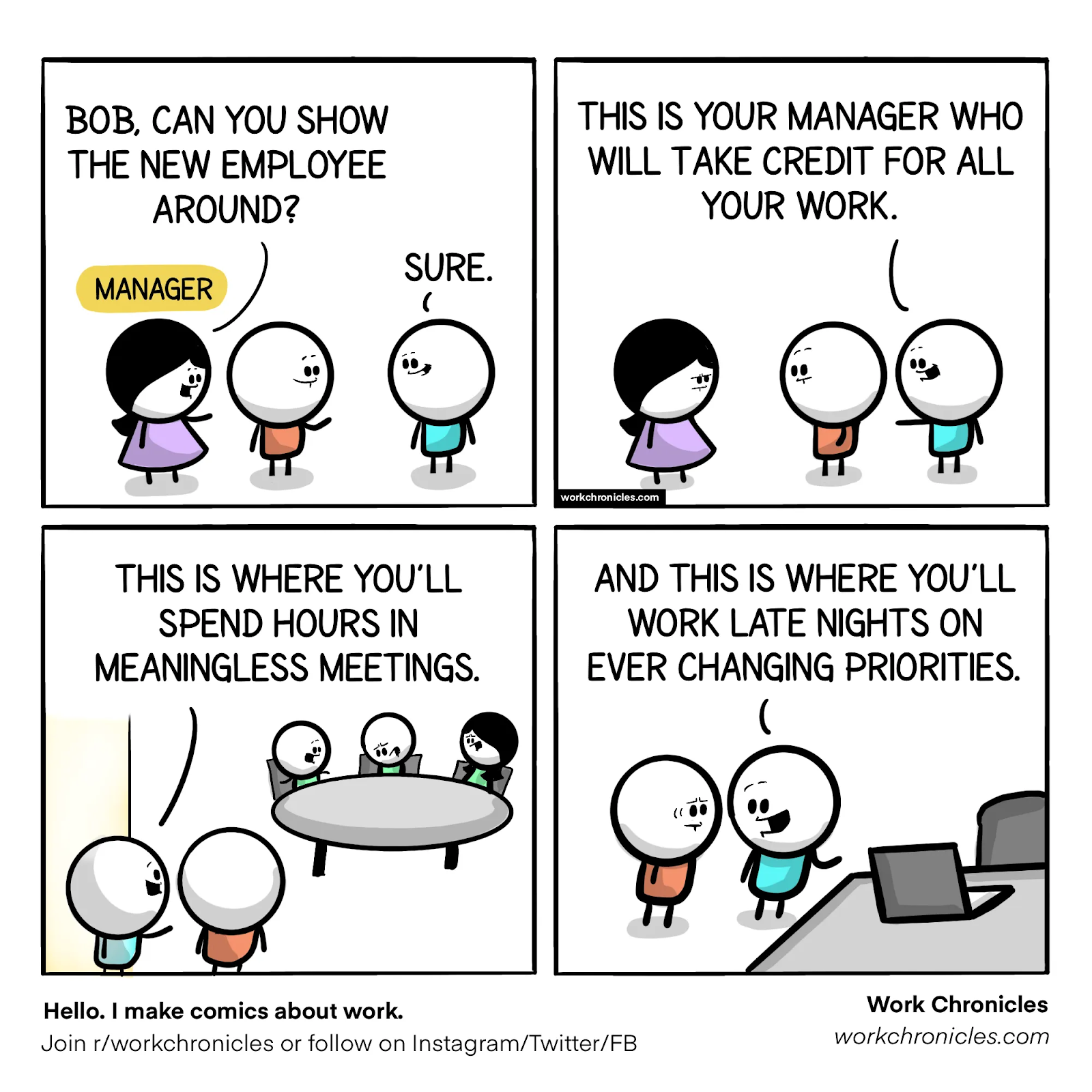
THIS IS YOUR MANAGER WHO 
BOB, CAN YOU SHOW 
WILL TAKE CREDIT FOR ALL 
THE NEW EMPLOYEE 
YOUR WORK. 
AROUND? 
SURE. 
(YAN G 
e 99 
workchronicles.com 
AND THIS IS WHERE YOU'LL 
THIS IS WHERE YOU'LL 
WORK LATE NIGHTS ON 
SPEND HOURS IN 
EVER CHANGING PRIORITIES. 
99 
Hello. I make comics about work. 
Join r/workchronicles or follow on Instagram/Twitter/FB 
Work Chronicles 
workchronic/es.com

Bonus: New Starter Packs

When I started, I think all I got was a writing pad to make notes. Maybe I got a pen.

Years later – existing staff, and all new staff were also given a water bottle, and a company-branded hot drinks flask. Even though it’s a simple thing, everyone seemed to appreciate it.

More recently, it was announced that “New Starter Packs” would be posted out to all new starters, and we were asked for feedback on the contents. I don’t get why they didn’t anticipate some backlash because they only planned on giving them to new starters. Also, they clearly had already ordered a certain level of stock because they were taking photos of them and had quite a few company-branded items.

There were the obvious choices of pen, paper, post-it notes, drinks bottle, in addition to some chocolates, sweets and some other miscellaneous items.

“The new starters will be there with their fancy laptops, new starter kit, and high wages, laughing at us”

Me

Some people criticised the choice of unhealthy treats, given some recent schemes to promote healthy lifestyles. There was also a Webcam Cover you could put on your laptop, which someone questioned if our IT department had approved it – to which the Head of IT said they weren’t authorised because they “crack screens and they also damage the bezel of other laptops when removed.”

It was also only for staff based in England, but a high percentage of staff are now based in India, so the managers admitted we need to find a supplier over there too to be fair.

So it wasn’t a well thought out idea really.

The Phantom Bogey Wiper & Sub-human Antics

I was looking through my work emails, looking for some classic stories, and found the story of The Phantom Bogey Wiper.

From: Lee Davidson
Sent: 10 May 2010 14:42
To: Development
Subject: If you're the phantom bogie wiper please take note!!!
Importance: High
 
Apologies to everyone for my tone in this email but some filthy scummy piece of excrement who’s most likely one of our colleagues has been wiping bogies on the toilet walls.  This isn’t something that happens by accident, the offending vile contemptible excuse for a human being must be making a conscious decision to offend others so I’ll not hold back in my show of disgust at this utterly pathetic person. 
 
Whoever you are and you know who you are could you put a stop to it please?
 
Regards,
 
Dave. 
From: Lee Davidson
Sent: 27 May 2012 10:26
To: Development
Subject: Toilet etiquette

Dear Colleague,

It is with great deal of regret I send this message but the sub-human antics of one or more of my male colleagues in confines of a toilet cubical have left me appalled and disgusted.

I can’t believe I’m typing this but could the person who is treating the toilet as their own personal cesspit please use the following etiquette.

·        Do not wipe your bogeys on the cubicle wall.
·        Do not spit chewed toilet paper on the toilet door.
·        And worse of all do not smear your excrement on the cubicle wall.

If you’re the person responsible then please remember you share this toilet with civilised human beings.

Best Regards,
David.
Lee Davidson
From: Richard Hirst
Sent: 29 March 2012 10:36
To: Keith Hanrahan; Me
Subject: FW: Toilet etiquette

Stay vigilant people… The toilet related incidents have been much better upstairs since Testing moved downstairs, any suspects?

From: Me
Sent: 29 March 2012 10:40
To: Keith Hanrahan; Richard Hirst
Subject: RE: Toilet etiquette

Ben always said he had poor hand-eye co-ordination. Maybe bum-hand co-ordination too

I can’t believe I wrote that in an email. I don’t think we had chat apps back then though. I shared it with a colleague:

Sadiq Khan: 
In this day and age, that's a ballsy email

Me  09:15
11 years ago :scream:

Sadiq Khan  09:16
Makes sense for that time

Me  09:17
back in the dark ages where we wiped poo on the walls
From: Scott Simpson
Sent: 27 August 2015 13:19
To: Development
Subject: Toilet etiquette


Apologies to all the female members but having to send the below out again!! Credits to Lee Davidson for the initial email 3 years ago.

I have added a slight addition after a harrowing experience yesterday!
·        Do not leave your excrement all over the toilet seat or around the bowl – It is NOT the cleaners job to clean after you!

Scott Simpson
Product Owner
From: Norman Taylor
Sent: 24 November 2015 10:16
To: Development
Subject: RE: Toilet etiquette

Apologies once again to all the female recipients of this email!

I’d just like to reiterate Scott’s point below as I’ve spotted a second sighting of this in the downstairs loos! :/ Not exactly what I wanted to see after my morning porridge!

Norman Taylor
From: Mike Dean
Sent: 24 November 2015 10:18
To: Norman Taylor
Subject: RE: Toilet etiquette

That’s probably nothing compared to the state of the left-hand cubicle toilet seat yesterday afternoon, mate!

I had to force the contents of my lunch back into my stomach!
June 2016

Me 16:40: 
The Phantom Bogey-Wiper has been hard at work. There's a right collection in the toilet cubicle wall 
surely, there's not many people who it could be, unless there's more than one Phantom

Mike Dean 16:42: 
the phaaaantom of the loo-pera is here
disgusting

Me 16:45: 
in fact, the original incident that you sent me was 10 May 2010  
so 6 years on, the Phantom is still at work

Mike Dean 16:47: 
wow
who could it be?
I've been here about 6 years, but I have an alibi

Me 16:48: 
if it's the same person, they must have worked in those 3 offices, must be male, and in Development
but there could be multiple phantoms

We never did solve the mystery. I did suspect it was multiple people but quite hard to accept people would behave in that manner.

Employee of Choice: Culture

Intro

Last year, my employer announced an “Employee of Choice” scheme. It wasn’t clear if this was an official award or a self-awarded title. Essentially, they want to improve a few key aspects so that current employees would recommend working here.

I had previously written about the survey and the results.

There were a few key pillars: Culture, Leadership, Employee Rewards and Terms, Work Environment, Processes, and Branding. Many people were sceptical that there would be any meaningful improvements.

Discussion

I discussed the topic of Culture with a few colleagues. The discussion was triggered by me saying that: I was intrigued what they would come up with to improve culture – since the term is a vague concept. Is “culture” just a naturally-occurring subconscious thing that happens? Or is it something you consciously try to create?

One colleague said he perceived it to be more about the working environment. People always loved the job despite the lower comparative wages because of the perceived positive culture. He said most people worked closely, and that meant people went from colleagues to friends. The “breakout” room, where people can go have a break or have lunch, encourages people to talk as friends. The addition of the canteen had similar benefits and gave a great option to purchase good food. The office was located near a park which was also great to go for a lunchtime walk. So it seems his perception is about how you perceive your colleagues and your ability to relax.

However, he said now we work at home “All those have gone. All that’s left is the work friends but it is diluted.” (many have since left and you don’t get to see the remaining people without a lot of effort.)

Another colleague said “it’s hard to change the culture because it’s so ingrained“, which sounds like it’s more like emergent behaviour.

Culture Manager

After a few months, we heard from the manager who is leading the “Culture pillar”. He admitted that he has actually been thinking of what “culture” actually means. I think it might have been helpful for him to question that on Day 1, rather than after a few months. Better late than never, I suppose.

You hear about “toxic” cultures, and sometimes about inspiring cultures (sometimes you just hear of positive aspects of the big tech companies, like Google having a slide for a bit of fun). Culture is not a tangible thing like an employee benefit – culture is something that only lives in our heads.

Culture Manager

He goes on to say that what people perceive to be “culture” is “hard to quantify, evidence and even explain“. Some people may write it off as “corporate jargon“, yet others deem it as important. Since it can mean different things to different people, how can he even begin to improve it?

I guess another point is: if we did a survey scoring the culture, and people have wildly different interpretations – then how do you even interpret a rating out of 5, and can you trust it at all?

He then ends the post by asking us what we interpret as culture? but also shifts the perceived poor culture onto the general staff by saying

a positive and progressive culture is on us as individuals – our culture is what we make it and believe it to be.

Culture Manager

We were told that the managers of each of these key pillars of the “Employee of Choice” have been busy making meaningful changes, but this post really sounds like: after months of work, the Culture Manager has decided he has nothing to do; and if there is a poor culture – it is our fault.

Employee Responses

A few employees responded to his post.

“Culture is the sum of a number of things which are driven by actions and good decisions, both individually and also from managers. Individuals have to all travel in the same, right direction and leaders and managers have to set the direction clearly and drive everyone towards it.” 

Employee

Another employee stated that managers put the onus on individuals by reiterating the company’s “values”, but culture is mainly driven from the managers showing those values:

“The company’s values represent its ambition to have a positive culture, but don’t do much to enable it on their own. Even if individual employees want to behave in ways that represent those values, corporate culture has a lot of momentum which is almost impossible for individuals to affect much unless they’re in a position of power.”

Employee 2

I liked those 2 responses, because they are basically telling the Culture Manager “YOU ARE WRONG!”

Another gave a more modern, woke response:

“To me, a good, progressive and welcoming culture should be inclusive and celebrate diversity (of individuals, ideas and ways of working)”.

Employee 3

Jessie Marsch’s Spieler Rat

I came across the following quote from ex-Leeds United manager Jessie Marsch. 

Note: The “fine system” he mentions is when players have to pay a monetary fine for breaking some rule. Some of the rules can be humorous (wearing flip-flops in the shower) but others are important aspects like not being late to training. The fine system can set the standard for professionalism but also allow for a bit of fun too.

“I have a leadership council everywhere I go. In Germany it’s called the Spieler Rat, the leader group. I ask them things like, how do we want to travel? What do we want to wear? Have them make the fine system, you know. But then I go deeper. What do they think of our tactics? You know, I ask them about match plans. I’ll ask them about training, about video, about everything. And I want them to be fully engaged at all moments. And typically, if a player comes to me and has something important that he believes in, then I will almost always include it in what we do, almost always. Because if I really am asking them to commit themselves, and give of themselves, then I have to give room for that to take place. I mean, I could give you a lot of different examples of that.”

He is talking about his leadership style which I think sets the scene to what the culture is under his management. You could manage as an authoritarian or be more open like a democracy. It sounds like the greater vision is provided by Jessie, but instead of micro-managing, he delegates that to his leadership group. I think his approach will make the players feel valued and more open to contribute ideas.

Conclusion

I still think Culture is quite hard to define, but it does seem like it’s the collective mood; driven by managerial decisions, and the physical environment employees are in.

Glint Survey

Introduction

In this blog, I discuss a survey my employer sent out to all employees. If they use the results, then they should address highlighted issues (if any), and aim to keep positive aspects unchanged. 


“We are on a journey to become an employer of choice. This survey, and your feedback, will enable us to identify what to prioritise and focus on. We want to be guided by your experiences. Help us to help you.”

 
We have done surveys like this before, but then I don’t think anything really changes based on the feedback. I also find them quite vague and open to interpretation. If I was creating a survey, I think I would add examples to clarify the questions, and would also force people to justify their answers with comments. If you simply score 1-5, then when it’s a 5, what makes it so good? If it is a 4, what change would perfect it? If it is a 3, why so mediocre? or is it simply you just don’t have an opinion on it/don’t find it relevant etc.
 
I ended up clicking 3 for most of the answers, and didn’t feel it was worth spending time writing the optional comments as I felt it wouldn’t make a difference. Some questions were ambiguous, or unclear what they meant so I didn’t feel like I could score accurately. I think they will just look at the average scores and not really drill down into the details. Although that does go against their ambition of being an “Employer of Choice“. If they really want to be this (is this some kind of award/vote thing, or self declared? What does that really mean anyway?), then they need clear guidance so should ask for justifications.

Employer of Choice Programme

”This is a business critical programme with a number of SLT-sponsored work-streams that are focused on making us an employer of choice; where we attract, recruit and retain the people we need, enabling everyone to be their best self and deliver high performance.”

The Survey

So here are the questions, and my thoughts on each. 

How happy are you working here?

Quite a tough one to answer really. I find it is very comfortable as weeks can go by without much progress and managers don’t seem to care. I like the low-pressure environment but then I just think it’s becoming a bit stale in recent times.

I would recommend here as a great place to work.

Is it really possible to be really happy but not recommend it, or be really unhappy but recommend it? Surely these 2 answers will go hand-in-hand. Maybe there’s some edge cases, as I think if you like chilling, then it is perfect to work here. So some people could be unhappy but recommend it to others in that case! The last batch of people we have hired have basically done nothing for 2-3 years so I am sure they are happy in the short term. 

If you want a job where you are learning a lot, I think maybe it’s best looking elsewhere. There is a big push to create new features “in the cloud” but then these projects sometimes seem a bit forced and end up being scrapped. 

I think over time, long-term employees have been moving on. I think that’s a general problem seen across the industry now many software developers work at home. It’s easy to switch jobs without having the hassle of moving or large commutes. I do think this is a big reason. So with an increasing number of cancelled projects and more jobs moving to India (although recruitment over there seems to be struggling as well), maybe it’s not so great for people to start working here.

I understand how my work contributes to our success.

People got quite excited when starting working on a successor to our ageing, flagship software. But it’s been 3 years, the projects have been restarted or changed direction/vision. There’s general disillusionment when developers say “none of my code has reached production in 3 years”. Even people that are working on the flagship software have seen projects being delayed from release by 3 months sometimes. So it’s quite hard to see how your work contributes to success when many features just don’t seem to get released!

I feel a sense of belonging.

A few years ago, I think most people you could ask would say the people are brilliant. Unless you were the sort of person that came in, kept quiet and did your work, I think people would cite having several close friends. This has definitely dwindled over the years, especially since switching to home-working. Then like I stated before, long-term employees have been leaving recently which has eroded the “classic” culture.

I am able to successfully balance my work and personal life.

I think we score highly here because we are never pressured. Even if you miss deadlines, managers often seem happy just to delay things. One colleague recently stated he “has never known a deadline that couldn’t be extended”.

I have a good working relationship with members of my team.

My team is actually composed of long-term employees so I think we have a good mix of knowledge of the company and determination for the software to be of good quality. I think in general, small teams do work well together.

I feel satisfied with the recognition or praise I receive for my work.

To be honest, I am always ranting about how managers just hype up everything. It seems really disingenuous. Then there have been instances where projects are a mess but you get praised for getting them over the line. It’s gonna get done if you extend the deadline long enough!

People then get praised for dealing with a tough project even though it was clearly bad decisions from the team that caused the delay/bad quality. It means when you do get praised for doing something good, it’s hard to know if it is actually sincere.

I feel comfortable being myself at work.

I’m not really sure how to interpret this. In today’s woke culture, it sounds like it’s asking if you are comfortable stating your sexuality or something. I don’t think I have to pretend to be someone else, so I guess this scores highly.

I feel empowered to make decisions regarding my work.

Not sure about this one either. I do question requirements, but ultimately it’s the Product Owner’s decision, and they are taking orders from above.

I have good opportunities to learn and grow.

I think each day is the same really, so no new challenges.

My working environment allows me to work at my best.

I did wonder how people interpret this question. If we work at home, is it a critique of our own space? Do people just consider their work equipment (computer, mouse, keyboard, monitors)? Would people interpret this to be about software? People they work with? Managers?

I have the resources I need to do my job well.

Now this sounds more like hardware and software, but is it?

I am excited about The Company’s future.

With our ageing flagship software and our upcoming software keeps changing direction/restarting/delayed – the future seems grim in my opinion. I was discussing this with a colleague recently. If a competitor releases new software before we do, then we could be screwed if ours still needs years to be suitable for release. We announced it early too which means other companies could be provoked into making a similar product in order to be competitive, especially since we hyped up key features that weren’t even being developed at the time.

The Company has a great culture.

“Culture” is a very vague term really. I think this is more of a culmination of aspects. Your peers, managers, processes/rules, unwritten rules (e.g. expected amount of overtime). It’s a bit mixed really. I generally like the people, but there’s a few people who definitely chill out, recent recruitment has been poor, and some processes are just box ticking…

We do a good job removing barriers that slow down our work.

Not sure again. I think we have been increasing focus on security and that slows you down, like losing Administrator rights to our computers. Want to install something? Have to go through IT. Sometimes we seem to add more “box-ticking” exercises for things and there doesn’t seem to be much rationale/benefit for these.

There is a good flow of communication between leadership, departments, and teams.

We like to organise “Town Hall” meetings, or Directors may make little blog posts on Yammer etc. But then we do the weird thing where managers send an email to their line reports who have to send the email on to their linereports who have to send the mail on to theirs. Then someone in the chain doesn’t then people don’t know about key information.

Teams collaborate effectively to get things done.

I think the projects are often self-isolated so I haven’t had much experience of this recently. But when I did work on our upcoming product, the teams were duplicating work or doing work that would be useless – like making an API that no other team wanted.

Regardless of background, everyone has an equal opportunity to succeed.

Never noticed any classism, racism, sexism. I think sometimes the promotions can be quite cliquey and women seem to be allowed extended maternity then come back into a promotion. So I think some evidence of positive sexism, if anything.

Employees are held accountable for their work.

Disagree with this one. The most delayed project I have ever been on resulted in a one-off bonus of £1500 on completion. Others cashed in on overtime. Yet, if they were held accountable, then they should have been criticised for their decisions which led to such delays.

I have confidence in the leadership team.

I don’t know who is accountable for what, but since our new software has overrun by years, and obvious mistakes have been made, I’m not sure what they are doing about it or why it took so long to respond to it.

My manager keeps our team focused on clear priorities.

Hard to answer again. Sometimes people moan that they get asked to fix a bug instead of carrying on with their projects. But obviously high priority bugs will always take priority. Managers in charge of several teams love moving team members around as if staff are purely interchangeable. This has been a problem for a while, but particularly in recent years.

My manager provides me with feedback that helps me improve my performance.

Well, we often come up with some super new appraisal framework then never really use it: we come up with objectives but then don’t review them and change the process again next year because it was deemed the current one didn’t work.

I am satisfied with the benefits offered.

We hype up generic stuff like “cycle to work scheme” which makes no sense when you work at home. Sometimes we promote voucher schemes and stuff but you often just save 2-5% here and there.

We are committed to protecting the environment, promoting social equality and diversity, and supporting our communities.

Sometimes we promote initiatives like tree-planting and some charity fundraisers, but aside from that; no idea.

I believe meaningful action will be taken as a result of this survey.

Since we have done these surveys before, I think little action will be taken. I think because the questions were a bit vague and open to interpretation, it’s probably hard to glean much information from it. If a question scores an average of 3, what does it really mean? You would have to analyse the comments. But then if people have interpreted the question differently, then the score becomes meaningless anyway.

What else is on your mind?

I generally don’t like surveys 😀

Conclusion

I probably could provide good insight to the senior management, but A) the questions werent that clear and B) comments weren’t mandatory. Even though I didn’t write comments, it still took me 20 minutes or so to complete the survey. I discussed it with a colleague and he said it was easy to fill in and took 5 minutes. Then when I asked him how he interpreted certain questions like the “work environment”, then he admitted that he never considered all that detail. So the results of a question like that isn’t going to be useful.

Employee Forum

An “Employee Forum” was created recently. Each month, a group of representatives from different departments talk about suggestions and complaints – to try and improve life at work. These are then proposed to Senior Management or Human Resources to hopefully implement.

Personally, I can’t imagine this lasting because many suggestions are illogical or have just descended into madness – and there’s only been two meetings over the 2 months.

I think no matter how good things are, people will always suggest more time off, higher pay, or both. Many of these suggestions do involve more time off, and it seems we have tried every angle already.

Some of these suggestions have company responses already.

Offices are not being used. Are managers encouraging the use of them?

Response: Will re-communicate about the offices to encourage colleagues to use them.

My take: Since we now are all home-working, the office is barely used. It’s optional for people to work so some people work there permanently if their home isn’t suitable, or they come in when their team does. Now it ain’t an “office”; it is a “collaboration hub”. I think it’s important to include this one in the blog to set the scene. The office improvement suggestions are funnier given that the office is under-utilised; it’s like they want more perks than we had before when the office was 100% full capacity – which doesn’t make financial sense.

What is the official business position on dogs in the office?

Response: Dogs are not permitted in the office. Multiple reasons are behind this, such as colleagues with allergies, or aversion to dogs. A dedicated area for dogs within each office is also not permitted.

My take: Did people ever want dogs in the office before? This isn’t the strangest suggestion, but this is what I mean by descending into madness. How was this one of the first suggestions? Surely we should prioritise bigger issues.

Would we consider offering everyone an extra day holiday for life events?

Notes: Representatives discussed and came to the conclusion it’s fairest for it to be a birthday specific holiday because other life events, such as wedding day, may not apply to all. Will take this to HR.

My take: I like how the representatives consider a wedding day might not apply to all, but later they soon forget this and start demanding more maternity leave/pay; even though that is for child-bearing women specifically. You can never really be consistently inclusive anyway.

The general sentiment of a birthday holiday is nice, but then there will be people that will say they are too busy at work to take it off, so then will want the day off later. May as well just increase everyone’s holiday allowance by 1 rather than dictating a specific day.

Could we move to a 4-day working week approach that other businesses are adopting?

Notes: This means working 4 days of standard hours with the same 5 day salary.
Representatives discussed how this would work in supporting our main customers who operate 24/7. Will take this to HR.

My take: Imagine the conversation that person has with HR:
Representative: “what do you think of an extra day holiday?”
HR: “Rejected. Not gonna happen”
Representative: “Ok, next question, how about we only work 4 days?”
HR: “what? no!”
Representative (as we will see later): “How about loads more holiday?”
HR: “get out of here!”

I have heard some claims that working 4 days is more effective. I can actually see it both ways. When it is Friday, people often take longer breaks or work slower because “it’s Friday”/”it’s nearly the weekend”. If you remove the Friday, some people may work faster to get the same amount of work done, or they could just adapt the “it’s Friday” thought to “it’s Thursday”.

The Return to Work Program needs to be rethought.

Notes: An example of this is an employee who came back to work in December from maternity leave and was told from HR that the ‘Return to Work’ program starts in April (apparently runs every quarter) so she would have to wait a good 3 months to get the return to work support.

Response: We need to address this.

My take: Well, this just sounds like a dumb thing we do. How has the return to work program failed that much? What does this Return To Work program even involve? Are people introduced to any new employees and told about new/changed processes? Surely you would be aware after 3 months back at work anyway.

Offices used to have refreshment options available on site: vending machines, fresh fruit, and hot drinks machines, and a canteen serving hot food. The only facilities now are tea/coffee.

My take: What do you expect here? We had a canteen, fruit, and vending machines because the office was full. It currently operates on less than 10% capacity. It doesn’t seem feasible to supply fresh fruit. Vending machines are a possibility since the products will have a longer shelf life (but I bet those are pricey to rent anyway). Canteen was nearly shut down on a few occasions because it wasn’t profitable enough. A different office also requested they want a Canteen and even suggested people would pay a monthly fee to run it. It used to cost £3.75 per hot meal and I used it most days so I was spending ~£75 a month if there’s 20 work days. The fee would be significantly higher than this to make that profitable with fewer numbers of staff using it. No way are they going to pay that. Can’t people just buy some food on the way to the office? I think we still have microwaves if you want to warm food up. If not, ask for the microwaves back!

The UK Parental Leave policy is not very competitive

My take: Not sure how we compare to other companies but I’ve found that women can take something like 9 months maternity, get 1 month full pay, then can take 2 months unpaid leave, then return to work on reduced hours. What more do they want? Maybe it’s controversial and a minority view, but I don’t think people need to be encouraged to start families or be paid at their employers expense. We are paid to work, not chill out, but you wouldn’t think it with the requests for more holiday, reduced working hours, more social events etc.

Compared to many other companies, our Maternity policy and pay is very basic. This could be a deterrent to people wanting to start families. The return bonus is a good feature, however doesn’t assist with the cost of living whilst on Maternity leave.

My take: It is such an outrage; it’s on here twice! Seems the current policy is a “deterrent”, so I was wrong and people need to be encouraged to start families, then receive a “Return to work” bonus to get them back in. Insane. Also, what do they mean with “cost of living”? We mostly work at home now, so the costs of chilling at home shouldn’t increase.

Can we build a few bug hotels and bird tables in the gardens?

My take: “What? We can’t bring dogs in? What about bugs?” WTF. I hadn’t even heard of a “bug hotel” until now. Who is suggesting this nonsense? It’s making me angry reading this. Might make some sense if the offices were full, but they aren’t.

People who currently have an entitlement of 28 days annual leave should still be allowed to purchase 5 days, otherwise it is a scheme that doesn’t apply to many (it’s really 2 days purchase available).

My take: I think new employees have 25 days plus the usual bank holidays, then over years of service, it can go up to 28. But then you can purchase days up to 30. So the ask is that we should be able to buy 5 regardless of current allowance.

Recently, I was saying to some of my colleagues that 28 days is a fantastic annual leave and those in the USA barely get any leave at all which surely would make them go insane. But look at us chillers, we want more than 28 days!

Can we review holiday entitlement for length of service and/or senior roles? After 14 years, I have 28 days per year, whereas rival companies are on 35 to 38.

My take: They wanted to buy 5 days on top of 28 for a total of 33. Now they have increased their demands. “Can’t we just have 38 instead?” What’s the next demand? “Buy 5 days on top of 38”?
Do we still want our birthday off as well? These demands are just escalating.

Can we get a fleet of ‘Boris’ bikes to allow people to get off-site and obtain lunches from local businesses without the need to get in their cars or walk across muddy fields?

My take: Boris bikes refers to what they have in London where you can rent bikes to cycle around London. Here is a bonus fact: even though Boris Johnson was the London Major when the bikes were introduced, it was actually the former mayor Ken Livingstone that started working on the plan.

So we want to hire bikes to cycle to get food. The nearest supermarket is literally 10 minutes if you walk slowly and there’s only fields if you leap over the wall onto private land, so no idea where that false claim has come from. If you walk the other direction, there’s a few shops where you can buy food within 5 minutes walk (and can take a scenic detour through a park; no muddy fields this direction either), and a few pubs that serve lunch also within a 10 minute walk.

They want bikes because they are too lazy to walk, but would they cycle? isn’t that more effort? Locking/unlocking the bike at your start and end destination. Probably have to put a helmet on for health and safety. The extra hassle if the bike gets stolen… ain’t nobody got time for that.

Subsidised Pet Insurance – Wellness Allowance, £360 per annum to cover anything health related, Gym, massages peloton etc

My take: why not just ask for an extra £500 wage increase?

Anyway, I’ve got tired of critiquing these demands. I vote to stop the Employee Forum. It has clearly got out of hand already, and there is no way the majority of these are even going to be considered. I think all that will happen is that we will be encouraged to use the current offices more (and they may reinstate a vending machine if we do), and I could see maternity benefits being increased slightly. Everything else will be laughed at.

Office Tales

Introduction

Going to the office 5 days a week for my Software Engineering role was such a standard thing until the whole Coronavirus and lockdown became the new world. It’s crazy that my employer doesn’t have any interest in us returning to the office other than for optional collaboration. I mean, it does make sense, but it’s a complete u-turn on their previous ideals. We used to have a few offices nearby, but I think we only have 1 now. They redecorated the remaining office, cutting down the number of desks, and we are allowed to book time in the office if we wish, either individually or as an entire team. I have never been in though, and have only seen a handful of colleagues on a recent night out.

Things I miss about the Office

I think I miss the conversations you overhear from nearby desks, and communication is much more efficient when you can just walk over to someone’s desk. There will be people that you don’t need to interact with for your current work, but will acknowledge them as you walk about the office (often going/returning from lunch breaks). So it’s much more social when working in the office. I think there is a general awareness of what things are happening across the business, because you see people moving about and hear them talking about work. Now I only get that information if people post on communication software such as Slack/Yammer.

It seems I have quite a few draft blog posts that aren’t that exciting on their own, but I’ve put together a collection of ideas to reminisce about office life.

I’ve just discussed some things I miss about the office in this introduction, but the rest of the blog is basically “Things I don’t miss about the office” and “Other tales”.

Things I don’t miss about the office

Moving Desks

Every so often, managers decide to reassign loads of people between projects. Then, if the team sizes aren’t the same, they have no choice but to rearrange the desks, or simply relocate teams. This meant the entire department would move, even if the new desk is just 1 desk away. It was a major disruption and was basically a waste of half a day. People tended to unplug their PC a bit too early, but you did have your PC, 2 monitors, keyboard, mouse, drawer unit, then loads of cables and other items. It’s a big chain of moves though because you can only move if your new desk is free, but it is only free if the current person’s new desk is free and so on.

There was supposed to be a big move shortly before the lockdown happened. We were told that it was coming but then seemed to get delayed but no announcement (so no one knew what the holdup even was). 

I was told I was moving desks by my manager. An entire month went by with no update. I ask my manager what is going on. He says “I’ve been asking many times and I don’t get a concrete response. If you hear anything before I do, then tell me“.

A few days later, I heard another team talking about the new seating plan. I told my manager as requested.

He says he has the seating plan “but I need to spend some time to digest it“.

What are you on about? Just send it to me.

It’s a seating plan that has been released, and many developers were already reading it. Why is he making out it’s something he has to analyse then explain to me?

Anyway, the conclusion is that desk moves are very disruptive, managers find it a really hard task and they change their minds about it, then this makes it seem like a bigger event than it needs to be.

Sounds Of The Office

When I need to concentrate on programming, I often put my headphones in and listen to music. Drowning out all the random talking really helps you focus on your work. If people are talking, I’d often want to listen just in case it is something interesting and work-related, or maybe some funny casual chat that I want to hear.

Periodically, I’d take my headphones out, or maybe I would have to because I want to speak to someone or have a meeting.

Although the general sounds of the office were fine, there were some sounds that would do my head in.

Many people also used headphones to listen to their music, but there was one woman that often had her music on really loud. One time I looked over and saw that she had hair covering her ears, a beanie hat over that, then the headphones were placed over that. So the speakers have to go through a hat and her hair to reach her ears. No wonder she has it that loud. Also, I found it more distracting if I recognised the song. When Tool’s highly anticipated Fear Inoculum came out, she was listening to classic Tool every day and it went on for well over a month.

There were a few people with really exaggerated laughs. In previous blogs, I have mentioned one guy which I nicknamed Beavis for his style of laugh, but there were plenty of others that often did a fake laugh. One person sounded more like they were in pain rather than having a good time. It stressed me out.

There was one person that coughed a lot but it was more like a “ah mmm” like a stereotypical teacher would do to get a student’s attention. It wasn’t aggressive enough to actually clear her throat so it just seemed pointless to me, and extremely annoying.

Maybe the worst thing is this next subject, because I wouldn’t ever consider doing this whilst at work. I didn’t realise until I heard these sounds in the office, but I think it is a sound where it’s very satisfying to hear when it involves you, but hearing someone else do it; then it is vile. There were 2 managers sitting a couple of desks behind me, the woman was filing her nails and the scraping sound was very distracting. The worst thing that had me cringing though – the male was clipping his nails. Like I said, really satisfying if I am clipping my nails, but hearing that “click” sound on someone else’s; it had me cringing. I had to put my headphones on and crank up the volume, and try to not imagine those fingernails fly across his desk.

Kicked out of large meeting room

Meeting rooms were a really in-demand thing. Managers do love meetings, especially pointless ones. Then when you really do want a meeting, you just can’t get a room.

There were two meeting rooms next to each other, located near my desk.

  • Meeting Room A holds about 8 seated people, but you can get more people in if standing
  • Meeting Room B holds 3 people but you can get more people in if standing

I was called for an ad-hoc meeting with 3 other developers. Both rooms were free at the time. We take the larger room (Room A), since there’s 4 of us.

5 minutes in, someone knocks on the door

Sorry, I have a one-to-one and have booked this room

My fellow developers didn’t seem interested in arguing, so I followed suit and kept quiet. It’s a one-to-one so it’s a meeting for 2 people. Room B is perfect for them.

So after moving to Room B, we were trying to crowd around a laptop – crammed awkwardly in our seats. Meanwhile 2 people were sitting comfortably around a large desk in the opposite room. It looked ridiculous.

Office Tales

Empathy Lab

As I just explained, Meeting rooms were in high demand so we needed more of them. Of course, we like cutting down the number of meeting rooms for some cool initiative. One of them was the “Empathy Lab”.

“We were inspired in part by Facebook’s empathy lab which shows how people with impairments may interact with Facebook using assistive technology.

However, when building our accessibility empathy lab, it was important to us that it had a dual purpose: To raise awareness about accessibility, but also be an assistive technology testing space.”

I never saw it get used, but I did see many people get frustrated that they couldn’t find a meeting room.

The Recruitment Letter

Beavis gets a hand-written letter delivered to work written in a green pen. I don’t think I’ve seen anyone get anything delivered with their name on it that wasn’t a package, mainly from Amazon.

He opens this suspicious letter, and it is from a recruiter apparently from LinkedIn.

She explains that the unconventional approach to contacting him is due to the fact that his profile lacks detail and therefore that signals he doesn’t want to be contacted by recruiters.

<Sure, that makes sense.>

She likes the lack of detail in his profile though; it’s the kind of person she is looking for, so she wants to meet in person and talk at a Café.

I’ve never heard of this before? Is it a weird scam?

AWKS

Years ago, I wrote about how I was working in a team that was making the framework for a new application. One of our developers, Timothy, got moved to a team known as “Solutions Team” who were making a framework for the new application. I had asked him how his team differed to mine, surely we were doing exactly the same work? He said he was just doing what the managers told him.

A new developer, Nina joined the Solutions Team.

She comes over and asks Timothy to send her some documentation so she can understand what they have done over the last few months. (The correct answer is “nothing really, just messed about and partially duplicated another team’s work).

You could see the absolute terror in Timothy’ face. I think at that point, he was probably realising that I was right all along and their team was pointless.

Nina detects the panic and says in a concerned tone “are you okay?”

Timothy says “yeah” dejectedly, and then mumbles about “maybe he should update the documentation.”

Nina says she will come back later

It was the most awkward situation in a long time.

Just Paste It In

William has been working closely with a Junior developer. The Junior had a list of objects and needed a simple sort.

William is new to Javascript, but the syntax is exactly the same as C#. He looked at the method signature and didn’t understand it, so he told the Junior to google it.

The first solution they stumbled upon on Stack Overflow had an overly complex solution, but the original poster did request he required only one method that can handle sorting various items. Therefore it required an elaborate solution.

In the Junior’s case; he just wanted to simply sort a list; therefore this code wasn’t appropriate.

William told him to paste the complex method in and “it will work”. The Junior challenged him on it, asking if the algorithm sorted the items in ascending/descending order, and asking him to explain how the code worked.

William then just reads the name of the method and the parameters, trying to say some words in a confident way to blag that it was the correct thing to do: “It’s a dynamic sort, you just pass in the list, along with the name of the property you want to sort by“.

The Junior asks again if it sorts in ascending or descending order.

He then says “yeah you are right, this might not work“.

He had no idea what that code did, he was just hoping it worked – so was just confidently telling him it would work if he just pasted it in.

I ended up telling him how to do it. It’s a one line solution; not a 30 line method.

Change to avoid change

Where I work, we go for long periods with barely anyone leaving the business, then we seem to be hit with several at once. There’s been a few people leave recently when we announced we would switch from the standard Agile process to SAFe.

With this restructuring, some roles did change but I think it was mainly people that weren’t affected like Software Developers.

I was talking to one of my colleagues, and he said 

“Why are people leaving? it sounds like we will still be using the same technologies”

Developer

The thing is, Developers will leave if you make them use different languages, and Developers will leave because they want to learn something new, so you cannot win.

I think some people may be leaving because they don’t believe our new software will ever get finished, then they have used the news of the process change as a final trigger to leave.

It seems quite stupid to me though – a change in management/process often makes people leave, even though leaving means you are dealing with a new management/process anyway in your new company.

It happened when we moved from Waterfall development to Agile. It also happened when we moved offices, and we have moved 3 times; even though it’s always been 10 minutes walk at most to the new location. If you come by car, it’s not even a problem unless the parking situation is different.

“OMG IT IS DOWN THE ROAD, I AM LEAVING to an office further away”

Stupid staff member

I remember with one office move, I was in the new office kitchen and talking to a Developer who was leaving. He said “I’m sick of these office moves”. I pointed out that we were literally standing in the new office, so he has already gone through the hassle of moving. He said he was only here because he had to serve his 3 month notice period. Yet he was moving to a new job that was probably further away from his house, and would more likely to have more job pressure because it’s very relaxed where I work. Also, since we had moved office, you could essentially guarantee we would stay there for at least 2 years because of the building lease. At a new job, you will more likely have to move offices within that time period.

In my mind, a change should be an encouraging aspect to make you stay, unless one of the changes has a negative impact on why you liked the job. In my experience, it seems a lot of people don’t see it that way.

Crying At Work

I saw this statement posted online by a software developer (I won’t name them as to not call them out directly, although you could probably find it if you searched hard enough) and thought it was rather odd:

“Crying at work is normal and it happens to everyone”

Sad developer

As expected, people responded, telling her this isn’t normal. I would have thought it would be due to 

  1. Toxic working environment
  2. Bad/bullying managers (maybe ties into point A)
  3. Personal issues; not work related
  4. Maybe hypersensitive person

The thing is, if the job is that bad that it makes you cry, then you probably need to leave. Personal issues are understandable to cry, and it can easily happen in work-hours, but then it’s not “normal”; as in an everyday occurrence. If it’s a personality trait of such an individual to easily cry, then again, it is not “normal” because the average person wouldn’t react that way.

I asked one of my colleagues what he thought about it:

“if your work makes you cry, that’s quite a clear indication you should move on”

colleague

So he has the same line of thinking as me.

The original poster tries to clarify, ruling out that it’s a problem with the company culture or particular members of staff.

“If your job is making you feel upset or unsafe, that’s a different problem. But I often feel overwhelmed with coding and cry it out.”

Sad developer

This makes me think it is more related to point D, or maybe there’s not enough team support. If it gets to the point where you have been defeated, there should be other developers that can help you solve the problem.

She then posts a response to all the people that are still telling her it isn’t normal:

All the people saying “this isn’t normal, you shouldn’t cry at work“: there was the pandemic, many people are isolated and struggling. If I want to cry at work, I will. To anyone who thinks otherwise, I wouldn’t want to work with someone of that mentality.

Sad developer

For me, this ties into the personal issue scenario. This one is understandable but it’s not really work related. I’d say that can be partially solved by supporting team members and managers.

The thing is, I thought they were backpedalling a bit here, and rather than retracting the word “normal”, they were still trying to justify their statement. Additionally, the theme did sound familiar, and I did some more searching to see if I could find a previous quote from them. I was correct, I had read this before. This was from a time people worked in the office:

“I wish I could go back 5 years and tell myself that there would come a day when I wouldn’t cry at work each week and I would feel confident in my programming skills. It takes a long time but at some point you’ll realize how far you’ve come.”

Sad developer

Each…week. Damn.

So they were definitely trying their best to justify their statement rather than retracting it. It wasn’t about the pandemic at all, they just cry when their code doesn’t work, but they won’t accept that it’s not a normal reaction.

I think telling people it is normal is bad advice. I’m still going to stick with my opinion that it’s either a terrible place to work, or you have issues. Advising people to not leave the toxic job, or to not seek help for whatever problems they have – is definitely bad advice.

However, to play devil’s advocate and argue with myself, I did a quick Google search and found a few articles that quote the job site Monster who (apparently) performed a survey with 3,000 respondents. Apparently 8 out of 10 people have cried at work. Of those:

  • 45% stated it was because of their bosses or co-workers. 
  • 19% stated personal, non-work issues.
  • 15% stated workload, 
  • 13% said they were upset over workplace bullying.
  • I assume 8% were other reasons.

Note I stressed the word “apparently”. Weirdly, all of the articles I found didn’t link to Monster, and I searched Monster’s website and also tried to use Google to find the source. I saw evidence of a survey for that time, but no statistics on crying. There’s also an article about crying, but then it links to one of the news articles I found! Why would Monster quote a news article that says Monster did the survey when they could just quote themselves.

So what are we concluding? I’m one of the emotionless 20%, or crying isn’t normal and there’s some weird conspiracy.

A Day In The Life Of A Software Developer #1

At the start of the year, I thought of a new blog idea. I could pick certain days to give a run-down of the day’s work, including some banter. I drafted this up before the lock-down when we were working in the office. I hoped to write a few blogs in the series before posting them, but that didn’t work out. I suppose I could still write some based on working from home, but there won’t be as much banter to write about. So here it is. Note, this was when I was in a team doing a Web-based project:

I get into the office and give my previous day’s work a quick test before I send a Code Review to my team. I load up the website, open the menu… the menu is screwed up and won’t open at all.

I couldn’t understand what happened. I’m sure this was working yesterday. I spent some time analysing my changes; I really can’t see how this has happened.

The Junior Developer gets in and I ask him if he can give me any ideas on how this can happen. “Oh, I saw this happen yesterday.

What? You saw it, and never said anything? You didn’t log it, or even post it on Slack for the team to see?

No, it is a minor issue“.

I was outraged. I’ve told him not to ignore issues. We are paid to make things work. Also, if it was logged, I wouldn’t have wasted time analysing my changes when the bug isn’t even caused by my changes. If a bug is logged, if someone assigns it to themselves, then you know not to waste time looking at it, because it is being investigated. If the issue isn’t logged, you can end up with 2 team members looking into it because they think it’s a newly discovered problem.

We end up finding the cause, and we correct it.

Someone talks about a Pop music concert involving the groups: A1, Five, Damage and 911. “Sounds like a traffic report“, Seth says. We all laugh.

It’s time for the Scrum Of Scrums. Dean is currently occupying the meeting room on his own, but on a conference call. Helen waits outside and debates with a nearby colleague if she should kick him out of the room. Josh says “maybe Dean is waiting for the Scrum of Scrums?“. Helen says it wasn’t the case. Dean sees them awkwardly queuing outside, so he quickly leaves the room. The rest of the participants for the meeting show up. A minute later, Dean comes running back exclaiming “I should be in the meeting!“. I laugh at him.

A colleague tells me about a massive rant on Slack about the poor communication from management. I read it. It is brutal, but they make a good point. The upper management have kept quiet, when they used to hype up projects all the time. Additionally, new staff members have been quietly hired, some have even quietly left. We used to get emails to welcome the new starters, and also got emails to arrange leaving parties for departing staff.

Shortly after, some guy I have never seen before is asking a manager, Tim, about the progress of some important bug fixes. When he leaves, another manager asks “who the hell was that?” Tim replies “he has been here for 5 months, he is the latest Project Manager”.

Well, that certainly validates the Slack rant about the quiet hirings. No one in my team knew who he was either.

I’m happy with my work, so I send a Code Review to my team. I check to see if there’s any outstanding Code Reviews that I can review. Last week, I had left a comment about lack of test coverage. The developer hasn’t bothered adding any more tests. I ask him about it, he seems to be playing dumb. I told him I would sort it. So that is tomorrow’s work sorted.