Dave Plummer, who has the Youtube channel Dave’s Garage announced on Twitter:
Big news! Someone finally noticed that if you hold down CTRL, the process list in Task Manager conveniently freezes so you can select rows without them jumping around. I did this so you could sort by CPU and other dynamic columns but then still be able to click stuff…
Dave Plummer
There’s been plenty of occasions where Task Manager rows jump around to my annoyance. Why wasn’t this a more obvious feature? Frank Krueger (who appears on Merge Conflict podcast) made the obvious point:
Don’t hide features under random key combos – undiscoverable and unmemorable UIs are user hostile. A little checkbox with the text “Pause Display” would be discoverable and you won’t have to wait 30 years for someone to find your feature.
Recently, a team was created in order to tackle major issues, often proactively. Some errors are logged without the user noticing anything, so by monitoring the logs, the team can diagnose and fix these “silent” errors. The other thing they are looking out for is performance problems. Some performance problems aren’t noticed when it’s more of a minor increase, inconsistent, or slowly gets worse over time. I would think some users don’t bother reporting slowness because it’s harder to quantify than the obvious crash.
However, one user had been seeing a recent drop in performance by not dealing with their tasks, but it had got to the point where they could no longer log in, as it took longer than 30 seconds to retrieve their tasks on login – so it timed-out (as in an error was meant to be thrown when the time to retrieve their tasks took 30 seconds).
“At the time of logging this bug, the user currently has 136,854 tasks in Tasks Management. The Program performance will start to be negatively affected after 4,000 tasks. I have extended the timeout of sql call for TasksManagement.GetUserTaskCountSummary to 60 seconds as this caused a login failure.”
Walter (Developer)
“let’s be honest, the program performance will start to be negatively affected after 1 task”
Mike (jestingly)
I think this is acceptable as a quick fix to allow the user to login again, but is it really acceptable for the login process to take more than 30 seconds? I’d imagine it would take around 40 seconds for this user.
That’s the problem with this team, they just look for quick wins, even if it isn’t the right solution long-term, and might even move the problem elsewhere.
What’s better than waiting 30 seconds? waiting 60 seconds? or threading it off to delay the loading? or Mark’s idea: no timeout.
What if the time taken still exceeds 60 seconds, assuming some other user has a large volume of data? Can you set the timeout as infinity?.
Mark
we had a customer with a very large count and it only ran for around 32/33 seconds and their counts were unusually large. We are going to send out communications for customers to keep these low by means of maintenance. The 60 seconds just allows an extra safety net if we get in this situation again. I don’t want to extend the timeout to be too long for this reason as it will unlikely (if ever) be needed to be longer than 60 seconds.
Walter
Why not a try catch / retry attempt for this? It should be a non-essential call to logging in, if it fails, you can catch, log, and show an error message. Should we not look at optimising this so that you can login quicker? Maybe run this on a background thread too?
Lee
I discussed this with Johnny and making changes to this Stored Procedure could result in worse performance for smaller datasets and advised against making changes to it. We’re going to tackle this by means of communications to sites. I thought the simplest and safest approach is just to extend the timeout slightly so that the practice does not suffer a system down as a result of it – the timeout is only breached by a second or two. Once the user logs in, they are displayed their task counts, so I think it might be deemed essential (rather than showing them a loading wheel until the data is returned). Currently, if we did this, when loading up Tasks Management it would just crash with an error.
Walter
It would still crash on logging in if it takes over 60 seconds. Why not make it non-critical to logging in?
Log in
Status bar “Loading…”
Completes – OK.
Fails – Show error and retry link.
Lee
This was the worst site on the estate and was taking roughly 32 seconds. To take over 60 seconds the task count would probably be unheard of. Each time I ran that stored procedure manually, the results were the same so I don’t think a retry is going to work here. Even by changing to make it non critical to logging in, Tasks Management will still be busted when you try to load it. The timeout is on the SQL side so that is the area we need to resolve really.
Walter
However, Johnny did advise against alternative solutions such as: 1. fine tuning the stored proc 2. adding indexes 3. Remove tasks counts completely for some types of tasks
My View:
Walter seemed to have put more thought into it than I originally thought, but I still thought he was overlooking Lee’s suggestion. Yes, it would need more work to actually work (display loading text on the Tasks Count Bar, then loading screen when launching the Tasks Management page), but it would significantly speed up logging in. If this user could log in 32 seconds quicker, then what would the average user see?
If the other parts of the log-in process also take some time, then that’s a long time they are waiting in total. If taskcounts are the bulk of the time, then we can make it super fast if we take it out. I would have thought users would expect times of 5 seconds or less (might not be possible, but that’s the scale we need to aim for). Walter is talking like users are more than happy to wait 30 seconds or more just to get to the home page. A long wait is better than not being able to log-in at all, but surely it’s generally unacceptable to be more than several seconds in total. It’s one of the reasons why users have grown more discontent over time.
When doing some testing of smaller counts, for example 10k – the results are returned in a few seconds (2-3). This organisation had around 120k Appointments Tasks across all users plus all of their other tasks which resulted in a production duration of 32 seconds. The more they manage their tasks the quicker workflow will be, that’s always been the message we’ve tried to get across.
Last year, my employer announced an “Employee of Choice” scheme. It wasn’t clear if this was an official award or a self-awarded title. Essentially, they want to improve a few key aspects so that current employees would recommend working here.
I had previously written about the survey and the results.
There were a few key pillars: Culture, Leadership, Employee Rewards and Terms, Work Environment, Processes, and Branding. Many people were sceptical that there would be any meaningful improvements.
Discussion
I discussed the topic of Culture with a few colleagues. The discussion was triggered by me saying that: I was intrigued what they would come up with to improve culture – since the term is a vague concept. Is “culture” just a naturally-occurring subconscious thing that happens? Or is it something you consciously try to create?
One colleague said he perceived it to be more about the working environment. People always loved the job despite the lower comparative wages because of the perceived positive culture. He said most people worked closely, and that meant people went from colleagues to friends. The “breakout” room, where people can go have a break or have lunch, encourages people to talk as friends. The addition of the canteen had similar benefits and gave a great option to purchase good food. The office was located near a park which was also great to go for a lunchtime walk. So it seems his perception is about how you perceive your colleagues and your ability to relax.
However, he said now we work at home “All those have gone. All that’s left is the work friends but it is diluted.” (many have since left and you don’t get to see the remaining people without a lot of effort.)
Another colleague said “it’s hard to change the culture because it’s so ingrained“, which sounds like it’s more like emergent behaviour.
Culture Manager
After a few months, we heard from the manager who is leading the “Culture pillar”. He admitted that he has actually been thinking of what “culture” actually means. I think it might have been helpful for him to question that on Day 1, rather than after a few months. Better late than never, I suppose.
You hear about “toxic” cultures, and sometimes about inspiring cultures (sometimes you just hear of positive aspects of the big tech companies, like Google having a slide for a bit of fun). Culture is not a tangible thing like an employee benefit – culture is something that only lives in our heads.
Culture Manager
He goes on to say that what people perceive to be “culture” is “hard to quantify, evidence and even explain“. Some people may write it off as “corporate jargon“, yet others deem it as important. Since it can mean different things to different people, how can he even begin to improve it?
I guess another point is: if we did a survey scoring the culture, and people have wildly different interpretations – then how do you even interpret a rating out of 5, and can you trust it at all?
He then ends the post by asking us what we interpret as culture? but also shifts the perceived poor culture onto the general staff by saying
a positive and progressive culture is on us as individuals – our culture is what we make it and believe it to be.
Culture Manager
We were told that the managers of each of these key pillars of the “Employee of Choice” have been busy making meaningful changes, but this post really sounds like: after months of work, the Culture Manager has decided he has nothing to do; and if there is a poor culture – it is our fault.
Employee Responses
A few employees responded to his post.
“Culture is the sum of a number of things which are driven by actions and good decisions, both individually and also from managers. Individuals have to all travel in the same, right direction and leaders and managers have to set the direction clearly and drive everyone towards it.”
Employee
Another employee stated that managers put the onus on individuals by reiterating the company’s “values”, but culture is mainly driven from the managers showing those values:
“The company’s values represent its ambition to have a positive culture, but don’t do much to enable it on their own. Even if individual employees want to behave in ways that represent those values, corporate culture has a lot of momentum which is almost impossible for individuals to affect much unless they’re in a position of power.”
Employee 2
I liked those 2 responses, because they are basically telling the Culture Manager “YOU ARE WRONG!”
Another gave a more modern, woke response:
“To me, a good, progressive and welcoming culture should be inclusive and celebrate diversity (of individuals, ideas and ways of working)”.
Employee 3
Jessie Marsch’s Spieler Rat
I came across the following quote from ex-Leeds United manager Jessie Marsch.
Note: The “fine system” he mentions is when players have to pay a monetary fine for breaking some rule. Some of the rules can be humorous (wearing flip-flops in the shower) but others are important aspects like not being late to training. The fine system can set the standard for professionalism but also allow for a bit of fun too.
“I have a leadership council everywhere I go. In Germany it’s called the Spieler Rat, the leader group. I ask them things like, how do we want to travel? What do we want to wear? Have them make the fine system, you know. But then I go deeper. What do they think of our tactics? You know, I ask them about match plans. I’ll ask them about training, about video, about everything. And I want them to be fully engaged at all moments. And typically, if a player comes to me and has something important that he believes in, then I will almost always include it in what we do, almost always. Because if I really am asking them to commit themselves, and give of themselves, then I have to give room for that to take place. I mean, I could give you a lot of different examples of that.”
He is talking about his leadership style which I think sets the scene to what the culture is under his management. You could manage as an authoritarian or be more open like a democracy. It sounds like the greater vision is provided by Jessie, but instead of micro-managing, he delegates that to his leadership group. I think his approach will make the players feel valued and more open to contribute ideas.
Conclusion
I still think Culture is quite hard to define, but it does seem like it’s the collective mood; driven by managerial decisions, and the physical environment employees are in.
Conner pretends to be a NPC (Non Playable Character) from a computer game. His rigid walking and limited gestures and speech are hilarious. His content is mainly under 1 minute long to qualify as a Youtube short.
Kommander Karl
I recently discovered Kommander Karl. He mainly does gun reload videos. He pretends household objects are guns in first-person-shooter computer games, and reloads them, often with the help of some great video editing and fancy effects. Here are some of my favourites so far:
Recently, I came across a new jargon term, the T-Shaped Engineer. I think the general idea is that you used to have a “specialist” or a “generalist”. Now the perception is that it is good to have a compromise between them.
A generalist is like the adage, “A jack of all trades, but a master of none”. You learn new technologies but not achieve a deeper understanding – since mastering anything requires you to dedicate massive amounts of time to the craft. When challenging work needs to be done, engineers with deeper knowledge are needed; aka the specialist.
Specialists devote their time to a narrow set of technologies. They probably don’t learn the newest technology unless it falls into their specialist domain.
Work was often prioritised based on what resources were available. If a feature required more developers with a certain skill-set, and they weren’t available, then the development had to be postponed. If the company hires more developers with the required skill, when priorities shift, you can end up with spare/unassigned developers. This was a hard balancing act for the Product Managers. Sometimes, the developers could end up being asked to take tasks they wouldn’t normally do.
This has led to a new kind of engineer – the “T-Shaped” engineer. This describes a person whose knowledge distribution looks like the letter T. The horizontal line represents a broad knowledge in multiple areas, and the vertical one represents a specialisation of a topic.
Theoretically, having a full team of T-Shaped engineers with their own specialisation means that work can be prioritised. Whilst they may have a broad general knowledge, managers need to remember they can’t perform exceptionally everywhere. The concept isn’t a silver-bullet.
If “Pi-shaped” and “comb-shaped” developers exist, then you would think those would be the developers to hire. I suppose if you do find them, then they will be rare and demand large wages.
I found loads of chat logs from work, and additionally found a few quotes I wrote down from various employees. So today we are going to discuss the legendary employee Steve.
“Steve looks like a confused garden gnome that lost his hat”
Adam – colleague
Introduction
Steve joined as a Software Developer, and I think Steve’s carefree attitude meant his code was a bit inconsistent in quality. I liked working with Steve though, he was often quiet and just got on with his work, not really paying attention to anything else. It’s a pro and con really. Work got done (though often you had to prompt him to tidy parts up, or spot mistakes for him to perfect it), but then he didn’t know who many employees were because of the lack of attention around him. When he joined in the banter, he was quite “laddish”. A simple northern lad, Steve was well known to like his food and beer.
I just looked on his Facebook – and under “Political Views” it says “Democratic Alliance for the Betterment of Hong Kong.”
Andy
Sometimes he seemed to be quite unlucky and trivial events became more hilarious. Once, Steve opened up the window to let a butterfly out, and another one came in.
He always wore a t-shirt and even when the aircon was chilly, he loved opening the window. Sometimes even had the fan on whilst sat next to the open window.
Me 13:13:
how come Steve has a different body temperature to everyone else? Sometimes I think he isn't human
Andy 13:13:
haha, has he got his fan on?
Me 13:14:
he has the window open. Last week the air was directed at us so we were freezing. Now we have got him to open a different window, it's not so bad. Although, after a while, it does get freezing but Steve insists he isn't cold. Meanwhile Liam just said "I'm wearing my headset to keep my ears warm"
Knowledge of Colleagues
“I know people that are relevant to me”
Steve
Matt: "Do you remember Colin?"
Steve: "No, of course I don't"
“out of all the companies I’ve worked at before, I can only remember about 2 names”
Steve
Me: "Why is Simon leaving?"
Steve: "I don't care"
After our team member Paula moved up to Scotland and worked in our office there, Steve asked if Paula “was on her own, or if there was someone else on her team up there“. Paula is on our team, therefore if someone else was on her team, they would be on our team.
Charlotte asked Steve who wanted all these database changes and he said “John Bundy”. There is no colleague called John Bundy, and there never has been.
Matt: "The documents work item needs moving off the board because the Documents team are doing it"
Steve: "who is doing that? is it Gary?"
Matt: "No, it's Tony. You emailed him about it last week"
Steve: "Oh yeah, I did"
In his update, Steve once said “A chap called Jon Reaves has made some changes”. Jon had worked there for several years and is well known to everyone. Saying “a chap called” suggests he had never heard of him and thought he was new.
Food
Having 2 glasses of wine a week is unhealthy. You should be aiming for 30 units a week, mainly from beer.
Steve
“I’d rather eat my own feet than a KFC”
Steve
“Giving up beer and pizza is never a good idea”
Steve
Tracey was explaining how she went to London and had a fancy meal in Gordon Ramsey‘s restaurant. Steve chimes in:
“I went to Sheffield and had a kebab”
Steve
Matt: "I tried loads of stuff in Vietnam, no idea what it was"
Steve:[loud and affirmatively] "Bollocks"
It could have been testicles, Matt was explaining the interesting and different meals they have there, but it was funnier the way he said it like he had no doubt it was that.
“Four pints is what I call breakfast”
Steve
Steve was complaining that the office canteen has had “Toad in the Hole” for 2 days running. I said “I bet you ate it anyway”. Then he replies in a passive-aggressive tone:
“what else am I gonna do? eat the vegetarian option? Not likely.”
Steve
We once had 2 offices located close together. Our team had moved to the other office but we received a mass email from Mark stating he had brought cake in and placed it in the kitchen. Steve started walking to our kitchen (in the different office), Matt told him it’s not in that kitchen… but Steve checked anyway! He was desperate for that cake.
“Chickens come from seed which comes from oil”
Steve
Matt was originally talking about cars. Then Steve said all food comes from oil, then said that. I was instantly lost.
Software Development/Attitude to Work
“Matt! Myself and Phil are having a bit of a disagreement, and it’s about to turn to blows”
Steve
Matt: "Steve, have you done your Information Governance training?"
Steve: "I did it last year"
Matt: "what does the email say?"
Steve: "It said it is fine"
Matt: "Read it again"
In our team “Retrospective” meeting, we had to vote for “Team Member of the Sprint”. Steve voted for me. Matt asked him for the reason and he said
“I was hoping there wasn’t a second round of questioning”
Steve
A few weeks after finishing the Online Request project:
“Do you know how to switch on ‘Online Requests’?”
Steve
Me 13:41
guess how many unread emails Steve has. It's like he has been on holiday for weeks
Dan 13:42:
100
Me 13:42:
way higher
Dan 13:42:
500
Me 13:42:
closer, higher!
Dan 13:42:
I give up
Me 13:43:
550
No wonder he didn’t know what was going on.
His manager, Matt once stood at his desk and simply stated “Steve”, and Steve was baffled. I correctly assumed it was his one-to-one meeting. Even after Matt told him to check his calendar, Steve was still baffled what it could be. Classic Steve. Probably a meeting request in one of his unread emails.
We once had a meeting located in the main office. All our team dialled in remotely apart from Steve. From the video feed, we saw him walk into the meeting room late and say something to Adam.
Andy 12:36:
did you see Steve randomly turn up to the meeting?
funny as can be
Me 12:36:
yeah
Andy 12:36:
Mia had tears streaming down her face
Me 12:36:
why?
Andy 12:36:
cos why did he turn up when everyone else on his team dialled in
Me 12:37:
did he ask Adam if he was at the right meeting?
Andy12:37:
yeah!
“I was thinking of going for ‘Looks Good’ because there’s too many files”
Steve on doing Code Reviews. Too many files gets instant approval.
Charlotte: "what did everyone think of the meeting yesterday?"
Steve: "What meeting?"
Charlotte: "the meeting with Ronnie"
Steve: "oh, that. I'll be honest with you. I wasn't listening. I have no idea what was said"
Steve took an extended lunch break, and then later he went for a long walk. Matt challenged him on it "Didn't you go out for lunch as well?"
Steve said "yes" with a right cheesy grin
Doesn't care.
“Soon, I’m gonna be introducing lots of bugs. I’ve nearly finished my work; and I’m not dev-testing it”
Steve
Dan 16:18:
is he… what!? is he trying to get fired in the same way you'd act like a jerk to encourage your partner to split up so you get to feel morally superior?
Me 16:18:
haha, great example
A similar example…
Matt: "Steve, are you sure these changes haven't broken anything?"
Me (with fake confidence): "Yeah, because he ran the unit tests"
Steve: "Have I? I only ran the build"
Steve wrote a unit test with the following test data (Michael Jackson).
Me 13:53:
user.Surname = "O'Cake";
user.GivenName = "Pat";
Andy M13:53:
i'm sure i've seen that before
Me 13:54:
reminds you of your days in Pre-school
singing children's songs
Me 14:14:
OMG STEVE IS HILARIOUS
Matt googled Pat O'Cake and its a character from Bottom. He asked Steve about it, and he said "I wouldn't Google them all though, sometimes I use pornstar names"
Then a week later:
private const string _vouchingUser = "Bearstrangler McGee";
Andy 10:52:
wtf
Me 10:52:
Steve special
I never dare search for anything Steve puts in unit tests after he said "I sometimes use porn star names"
Andy 10:54:
haha
i hope that's not the name of porn star
Then there were some interesting reasons:
Me 14:48:
"CancellationReason\": \"patient has lost keys to handcuffs\"
why is Steve different?
Andy 14:48:
what the hell?
Me1 4:48:
const string cancellationReason = "patient was visiting a massage parlour";
Andy 14:49:
is he checking this stuff in?!
Me14:49:
yes, it's in our branch
Andy14:50:
he's an absolute lunatic
Steve was working on fixing a bug that Matt was also fixing (but we didn’t know it at the time). The next day Matt and Steve were both on annual leave, so Matt had handed his work over to me, and Steve handed his over to Jim. I finished my work, and Jim even passed my code review without even realising the similarity. It’s like a comedy show sometimes.
Steve had completed a feature, but his changes had broken Matt’s last bug fix.
“it worked for my user story”
Steve. It’s like the classic “it worked on my machine” that software developers love to say
Steve completed the work for saving Users to the database. I just tried it and it crashed. We asked him how much testing he did and he claimed it was all working. I showed him and he said “I forgot about that way”. There are only two scenarios, add from existing user, and add new user.
“I don’t think the Database Tool is working. I think it is completely goosed”
Steve
I just caught Steve smurf naming even though in his last code review, Phil told him not to. So then he looks up Smurfs on wikipedia. He clicks Smurfette and says “I’ll see if she is fit“.
I have no idea who brought a “dunce hat” in, but we decided that if you somehow break the build, then you wear the hat. Steve wore the hat quite a bit.
“I don’t need to wear the hat; I haven’t broken the build. I’ve just broken the product”
Steve
Not sure how he did it, but Steve once sent code to review which had the same title as the previous change he did. It also had the wrong User Story linked to it. (-‸ლ)
I told Steve that he was supposed to roll back one of his work items. After a few seconds he said it was done. I was sceptical. He said that I had already deleted the other part of the change. So I looked, and I hadn’t. He then said
“to be honest, I didn’t even look at it. I didn’t even compile it”
Steve
Miscellaneous
“Any advice that starts with ‘do not expose’ is good advice”
Steve
Liam was telling Steve that an angry resident left him a note on his car telling him not to park there again. Steve then comes out with this…
“Just piss through their letterbox”
Steve
We were playing badminton after work, and Steve said he had to rush off. Mike asked “are you doing something interesting?”. He said his parents were coming over later and he had a massive stash of weed to hide or smoke.
“I accidentally googled porn with my mum on mother’s day”
Steve
He was helping her with a crossword and the clue was “goddess of nature” and he wrote “goddess of mature“
At the start of the year, we were presented the “Technology Vision Statement” for 2022 by our CTO. Since we are around half-way through the year, I thought I’d revisit and critique it.
“The year 2022 will be the year of delivering cloud-ready, higher quality software at a faster pace. Our data will be integrated across products and be accessible via standard interfaces and we will begin a common user experience across our settings. Our business transformation will continue with SAFe, nurturing our talent management and the introduction of DevOps.“
Technology Vision Statement
So picking out keywords from this statement – are we on target for achieving this?
Cloud: Some teams are on projects involving “the cloud” but some of the projects are very basic and not exciting to the users. One project involves migrating a single column from a single database table into cloud storage. That’s right, one single column. The user won’t see any difference, it’s just some internal benefits but I think it has been a few months work.
Faster Pace: I completed a project back in January and I think we are planning on releasing it at the start of July. We are releasing software at the slowest we have ever done.
Data accessible via standard interfaces: I don’t know what this refers to. It sounds like we are implementing some amazing API that can work across all of our products.
SAFe: This is the Scaled Agile Framework for Enterprise. Most teams are working in this way, but my team isn’t.
Nurturing Our Talent Management: I think recruitment has been minimal and I think we have lost more than we have recruited.
Introduction of DevOps: We already had “DevOps”. I suppose we have improved the test environment pipelines so this might be the closest we have got to achieving this vision statement.
“Our people are valued, empowered and trusted. We are inclusive, authentic and thrive on our shared success.”
We were then shown a “hype cycle“. There wasn’t much explanation on this and I’d never come across this terminology before.
It looked pretty identical to this graph that I stole from the internet.
It had loads of products/features along a graph but the labels don’t exactly give a positive view on them. Are you hyped for a product that releases during the “Peak of Inflated Expectations“, or the “Trough of Disillusionment“. Maybe I need to read more into what this means.
Another similarity was that our graph had a lot of similar jargon-based features. Many that I didn’t think we would release, and I haven’t heard anything about these projects either such as: “Assisted Robots”, “Application Marketplace”, “Consumer Wearables”. Given the labels have products that are up to 10 years, I suppose they could just be conceptual ideas of where we want to be headed.
We then were shown a list of objectives under different categories which aim to “deliver the strategic vision“. Many are repeats from the vision statement, but then there’s added buzzwords and ideas like “innovation“, “increase efficiency“, “control costs“, “implement tech strategy“, and “implement agile coaching team“.
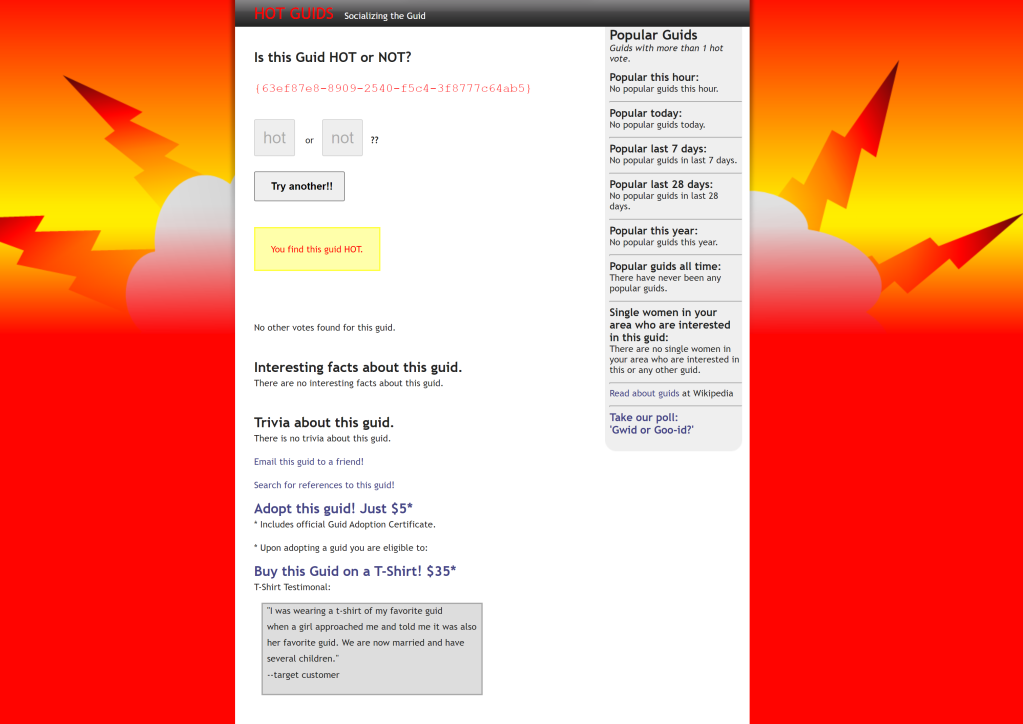
It’s a parody of those “Hot or Not” style websites that were popular years ago. It shows you a GUID and you have to select if you find it “hot” or “not”.
GUIDs are perfect as a randomly generated identification number since the probability of duplicates is very negligable.
Due to that trait, I would have thought the features of the website such as “Popular Guids – Guids with more than 1 hot vote” wouldn’t actually be implemented because the chance of showing you a GUID that was shown to 2 people would be basically impossible – so that’s part of the joke.
More humorous than that is this:
Single women in your area who are interested in this guid: There are no single women in your area who are interested in this or any other guid.
Then there’s purchase options like an adoption certificate or a t-shirt, although I don’t think you can actually purchase them, but I’m sure they would sell a few if you could.
“I was wearing a t-shirt of my favorite guid when a girl approached me and told me it was also her favorite guid. We are now married and have several children.”
target customer
Maybe that quote contradicts the other joke… or maybe there was only ever one single woman who was interested in a particular GUID. Or maybe the (fictional) reviewer was joking.
In case the website is removed from the internet, here it is in all its glory.
I’ve written blogs discussing incentives, and will probably write more in the future. One of my classic stories was how a Test Manager stated she was judging Testers if they run 10 Test Cases a day. Some people just ran 10 then chilled out for the rest of the day even though they would have normally done more work than this. Others tried to run as many as they could, but they ignored the harder Test Cases and ones that depend on 3rd parties. So:
A) it looked like we were nearly complete because the number of remaining test cases were low, but this last batch took ages to run so was very misleading.
B) We discovered that 3rd Party API/Test Systems were down at the last minute.
So this incentive actually helped delay our releases.
I’ve been watching a lot of Andrew Platt’s videos recently. He has many channels but this one he just reads stories from Reddit. It’s basically very low-value and easy YouTube content to make 😀
The stories he did on Rules made me laugh. It’s a similar concept to incentives; you are trying to change people’s behaviour by rewards/punishments, but if they aren’t well-thought out, then they backfire.
Here’s a few notes on my favourite punishments from the video:
If you’re a minute late that’s half a point, if you’re up to 4 hours late that’s half a point. So if you are gonna be late, may as well delay more.
Death penalty for stealing sheep. Welshmen caught stealing sheep would claim to be making love to them because the penalty for bestiality was lower.
Day care started charging a small fine for parents who picked their children late. This caused more late pick-ups. Could be that parents didn’t feel as guilty because it didn’t seem as much of an inconvenience. Also, it’s cheap childcare.
Bus drivers got banned from wearing shorts – so they all wore skirts instead.
Cobras were killed for a bounty in order to reduce the population. Enterprising people bred cobras to cash-in the bounty. When the reward system was scrapped, the cobras were set free, increasing the cobra population.
“Dry Counties” banned drinking. People would drive further away to drink, causing an increase in drunk driving.
Mandatory to drop heating temperatures to save on electricity. People brought their own heaters which increased electric use.
“Clean Desk” Policy caused people to put all their paperwork in an envelope and place it in the Internal Mail. It would arrive on their desks the next morning.
Dominos deliver pizza within 30 mins or it will be free. This increased car crashes as the drivers would drive recklessly to get there on time.
Several years ago, my Grandad decided to try learn how to use a computer and experience the internet. He went all-in and bought a printer as well.
One time, I went around to his house and he said he had problems with his computer. Anything that resembled any kind of error, he seemed to panic.
I can’t even remember what his problem was exactly, probably something like OneDrive failing to sign-in. When I followed him into his computer room, he picked up a stack of papers and handed them to me. I looked at them and he had printed out the errors!
I thought it was hilarious. I told some of my colleagues about it and it became and inside-joke, so if one of us has an error we would tell each other to print it out so we can help resolve it.
A few months back, I saw Wes Bos tweet this and it made me laugh because I felt it was something my Grandad would have done.


 Stranger Coding Tings