Top 5 Software Redesign Mistakes By Software Companies

I was watching Jayme Edwards’ (aka Healthy Software Developer) “Top 5 Software Redesign MISTAKES By Software Companies!” video, and thought he made some really great points.

Despite this being about software, I think a lot of this applies to Nintendo’s failure of the Wii U (hardware). I’ll first list my notes from the video (I did actually write some notes, then realised he had a great summary in the video’s description) then apply it to the Wii U in the last section.

#5 – Focusing On Current Customers 

“It’s tempting to focus on what current customers of the product have wanted at the expense of New customers. If the goal of a redesign is growth, it makes sense to do market research and look at the product with an open mind. Do new customers have completely different needs than current customers do? You don’t grow if you just convert the same customers over.”

#4 – Trying To Include All Features Of Prior Version 

“Many companies spend too much budget and time trying to design a product that does everything the prior product did. A redesign is the perfect point in a product’s life cycle to look at it with a fresh set of eyes before making a reinvestment. Throwing off the shackles of the existing product’s feature set might be exactly what your team needs to envision a dramatically more compelling, simpler, and better product for the market.” 

#3 – Budgeting Too Little For Marketing 

“As a digital software product becomes more established, many teams focus too much on the engineering side of the product. Is it possible that you might be better off budgeting a larger percentage of the investment in the redesign towards marketing? If you’re not doing Facebook advertising, Google Adwords, or Instagram posting to reach today’s audience you could be missing out on an extremely effective way to reach customers that you used to via a different source.” 

Companies can often try to piggyback off the previous product’s prior success. They may also have competition so need to advertise to strengthen the brand.

#2 – Failing To Consider A Rebrand 

“Though the benefit of an existing brand name and marketing message can be an advantage, depending on the age of your product and the needs of new customers, it may make sense to rebrand. This allows a team psychologically to detach from the prior product more wholly and look at the new version through a completely different lens. Might this be a strategy your company could use to bring life back to a product that’s no longer as compelling and exciting for the market as it once was?”

If you keep the name, you get brand recognition and don’t risk alienating current customers.

However, if you want to move into a new market, you may need a new name to grab their attention, or adapt to a changing market.

#1 – Failure To Establish Measurable Outcomes 

“The biggest and most common of the software redesign mistakes I see made is unfortunately the failure to truly establish easily measurable outcomes for success. As a project gets underway, unless design decisions were made to accomplish easily measurable goals, it’s easy for the team and management to lose sight of the purpose and simply look at the redesign as a “project” to be completed. It’s a huge opportunity to reach some exciting goals for everyone, and it provides cause for celebration to all those who were involved as they discover what the market wants!”

Get early feedback on the core product. Before you double-down on investing in the better experience, we need to make sure that everyone across the business has measuring goals so you know that you have reached your growth goal.

Wii U

Focusing On Current Customers – The Wii was a massive success in terms of sales numbers, but I think for most people, they only played a few games and then lost interest. This made the customer base an interesting one. Hardcore Nintendo fans are the ones that bought loads of games, but the casual audience is why so many consoles were sold. For the Wii U, Nintendo wasn’t really sure who it was for. It could play the old games but also had this tablet (“GamePad”) controller. The Wii’s appeal was the motion control remote and minimal buttons; which meant it was easily understood and had mass appeal.

Trying To Include All Features Of Prior Version – By supporting all the Wii controllers as well as the Wii U Gamepad and Controller, it was a bit of a mess with all the options. When playing Wii Fit U, some games like the climbing required a balance board and 2 Motion Plus supported remotes, then after you finish, you pick up the Gamepad to navigate the menus. Then you might go to Boxing, which wanted a Motion Plus remote and a Nunchuk. Way too fiddly and added to the confusion of what you even needed when purchasing the games.

Budgeting Too Little For Marketing/Failing To Consider A Rebrand  – They focussed too much on piggybacking on the massive success of the Wii brand, but people then thought it was just an add-on to the Wii. There was minimal amount of advertising so they definitely failed to not only get the message across, but many people just didn’t even know it existed. I even saw Billboard adverts for games such as Assassin’s Creed 3 which had the Xbox, Playstation and PC logos, but no Wii U. No idea if Nintendo had to pay to slap their logo on there; but it can’t help when even 3rd Party companies weren’t making it known the console existed.

Failure To Establish Measurable Outcomes – Don’t think I can comment on this one, but people thought the Wii U was rushed out for Christmas without much of a plan. Many games got delayed so there was barely anything to play in the first 6 months, and the operating system was so slow, even the “day one update” took several hours to download. It was like they just saw it as a “project to be completed” and didn’t think about how players would react to a lack of games, and a long wait to even get them to load (it took several months for Nintendo to fix the slow operating system).
Game Review: Say No! More

My previous blog was a review for the game “Game Dev Tycoon” which was relevant to this blog due to being directly about software development. “Say No! More” isn’t about software development, but it is about office culture and seems like a social commentary on people being overly obedient to please managers in order to progress through the hierarchy.

You play as an office intern who starts a new job alongside two others. The boss introduces the company and jokes that you have to say “yes” to go far. One of the interns is excited because she is someone who loves saying “yes” and pleasing managers.

Your character struggles to speak but he soon finds a cassette player with a motivational tape which teaches him to say “No” with confidence.

This manager has left his lunchbox at home so he steals yours. This leads you to chase him to his office to get it back, but you are constantly stopped by your colleagues with random requests. You shoot them down with your newly learned word: saying “no”.

“Can you get me a coffee?” “no!”

“Can you copy these documents?” “no!”

There’s even a few dialogues where you can wait for something different to happen, but there’s no negative repercussions if you do say “No” to them. The movement is automatic with on-rails movement and you just press a button to say “no” and move on.

In each chapter, your character listens to more of the motivational tape, and so he learns new powers like charging up your “NO” for a more forceful statement, or sarcastically laughing, clapping or nodding which catches people off guard, allowing you to shout them down. You also learn different tones: cold, heated, crazy, lazy. However, it doesn’t actually make a difference even though the Tutorial makes out that these different types are necessary against some people.

The game hasn’t really got any gameplay, it’s more of a humorous experience, relying on the comedy, quirkiness, and the ragdoll/destruction you see when you say “no” and knock them down.

I say it does succeed; it did keep me entertained for the 1.5 hours. If it was longer, then it would become tedious. It reminds me of Weebl’s cartoons; its wacky style, combined with some of the “No” voice samples which sounds like “Weebl and Bob“‘s way of speaking.

Game Review: Game Dev Tycoon

Since Game Dev Tycoon is about software development, I decided to review it and put it on this blog.

Game Dev Tycoon is a simulation game with a game development theme. You start off as a solo developer in your garage, making simple games in order to raise money to expand. Once you have accumulated enough wealth, you can purchase a new office which allows you to hire more developers and work on more complicated games. Later, a larger office is available which allows you to hire even more staff, and even have a Research, and Hardware labs (as long as you have a Design and Technology specialist).

When you start to make a game, you choose the game’s name, pick the Size (you start off with Small, then unlock further sizes as you progress), Topic (theme), Genre and Platform. A later upgrade allows you to choose the target audience; Young, Everyone, Mature. Then there’s 3 stages of development where you move sliders and choose extra features. 

  1. Engine, Gameplay, Story
  2. Dialogues, Level design, AI
  3. World Design, Graphic, Sound.

You move the sliders based on your assumption of the genre (RPGs have an emphasis on Story, Simulation requires Engine), and by the results and feedback of your released games. After release, you can then generate a game report which will give you hints on which aspects are important, and if the target audience and platform fit the style of game and theme.

For medium sized projects and above, you have to assign a developer to lead the development for each aspect. Adding additional features (e.g. Soundtrack, Surround Sound) and using game engines comes at a cost, but the more features usually means a better quality game. It’s not clear how random a lot of these elements are though, or if certain tech affects the genres differently.

Once you have created your game, you can wait a bit longer to put the finishing touches. The number of bugs will decrease and you can add extra points to Design, Technology. When you click “Release”, you will be given a review score and your staff experience within all aspects will increase. 

Money will come in from the sales with declining sales over time, and then the game is removed from the market. Your staff wages increase as they level up, and the general cost of development means it’s a good idea to have a large surplus of money if you can. If you do drop into negative figures you can get offered a short term loan but with extremely high interest. If you can’t afford that, then you are bankrupt. You are allowed to restart from your last save, the last office move, or you can just start again. The game can be tricky if you don’t land those big revenues at the right time.

As time progresses, games take longer to develop, require more staff and cost way more money. This is like real life when early computer games were developed by tiny teams over a few months. Those games may have been text only, or had primitive graphics with colours, but that was what the consoles could handle back then. Today’s “AAA” games take years to develop but have cutting-edge graphics and sound. So in this game you need to hire more staff, keep training their skills, and make sure you have the staff in the right areas. You can only have 1 game in development at any time.

As time progresses, new technologies become available for research, and Platforms are released or removed from the market. After a new Platform has been released, you can then buy a Development Licence to make games on that Platform (it would have been a nice idea to be able to work on games for the actual console launch though, then you would have the challenge of rushing your game out). The names and images of the consoles are slight variations to avoid copyright issues (or add humour to the game) but it’s easy to recognise what they are supposed to be. Each console is biassed towards certain genres and audiences. You start with the PC and Commodore, and it progresses to modern day with the Xbox Series and PS5.

You can take on simple contract work which gives you a small amount of money for a small amount of your time. The main advantage is to acquire more Research points. You can also develop games for Publishers but must create the game at a certain quality in order to receive the full amount. These contracts are more beneficial when you haven’t accumulated enough fans. Later on when you do have many fans, even mediocre games seem to sell themselves.

With your Research points, you can send your employees on training courses. You can Research new topics (which seems like a randomly ordered large list which is unlocked in batches), and technology. Once you have researched some more technology (mainly the improved graphics), it’s often beneficial to create a new Game Engine so you can use these features.

The Research room takes a lot of money to use. Even moving the slider slightly will cost $300k or so per month. You can research a Steam-like platform, the ability to make your own console in the Hardware Lab, create MMOs and a few other options. It’s quite hard to acquire these aspects before the game “ends”. You can carry on playing but new consoles won’t be released and there’s no “events” that trigger. 

There’s not many Genres but there are loads of Topics. However, I think some of the Topics should be classed as Genres such as “Racing” or “Sports”. Two other Genres that seem obvious to include would be Platforming and Puzzle.

I also wondered how the developer interpreted the genres especially when you unlock the ability to choose 2 genres (you cannot have multiple topics though). For example: what does “Adventure” mean? My assumption would be a point-and-click adventure such as Monkey Island, but then what does RPG-Adventure combo mean? Is such a combo doomed to fail, or do the developers have a different idea what this actually means? Maybe a certain Topic could fit this genre well? Casual is also down as a Genre, but I’d say this is closely tied to the size of a game. You don’t get major budget Casual games, although something mid-range like Animal Crossing. For the most part, the decisions seemed logical, but there’s probably some Topic-Genre combos that you won’t agree with because it is fairly subjective.

Just like most simulation games, I found myself playing for hours at a time and found it hard to put it down. It’s simplistic and definitely not for everyone, but I found it addictive and satisfying watching those number-bubbles float to the top and increment those total counts as your developers work on the game.

8/10

Unity Learn

Recently, I’ve been learning game development using the Unity game engine. Unity have made their learning platform “Unity Learn” free of charge since the start of lockdown.

The first learning pathway was very good, but the next one started off well, then seemed a bit of a random collection of lessons from various content authors. 

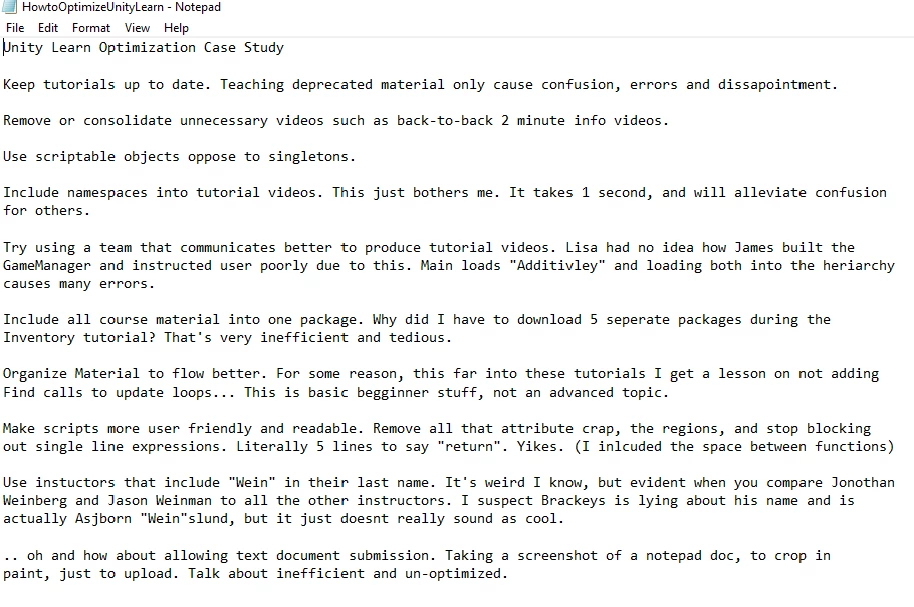
Some of the lessons are more about process, rather than writing code, and occasionally you are asked to submit something to demonstrate you have followed it. However, you could literally upload a blank file and it will accept it, so it is a bit pointless. Also, some of the file restrictions are a bit odd. On the challenge where you are supposed to research some ways of improving optimisation, you were asked to upload an image rather than a text document. 🤷

Once submission made me laugh, because it wasn’t about optimisation like Unity asked for, but instead, he gave a critique of Unity Learn.

He does make some good points, and I suppose most of these will only make sense if you follow the course. I’ve explained his final point though.

https://learn.unity.com/submission/60616140edbc2a2e6e4a24e5

I have watched quite a lot of Jason Wiemann and Brackeys. It’s a shame Brackeys stopped making videos though.

Star Wars: Knights Of The Old Republic II

Recently, I’ve been playing Knights Of The Old Republic II. On one of the missions, you board a spaceship with 2 party members with the aim of rescuing your main character. Whilst playing, the game crashed, and when I reloaded, I was controlling a character I didn’t recognise.

They had no equipment, average attributes, but what looked like fully maxed out skills. I was quite intrigued by the female portrait (my original character was male, and this newly generated character was also male).

When I went to the screen where it showed the party members, I saw the text:

“I am broken. So very, very broken”

It made me wonder how this came about. Was it some error the developers encountered but didn’t know how to fix? Or is it the case that they just put this code in just in case the game actually ever got into this state?

I didn’t bother carrying on to see what would happen. I did try reload a few times to see if it fixed the problem, but sometimes the loading screen would freeze. I loaded an earlier save and replayed the 20 mins I had lost.

Integer Overflow – Zaccaria Pinball

Zaccaria Pinball is a pinball game you can buy on Steam. User Breeze posted this screenshot of his score: 1,947,658,906. A negative score!

 What happened is that he has reached the maximum score, then it suddenly becomes negative.

I don’t know what language Zaccaria Pinball is programmed in, but in C#, the maximum value of an “int” type is 2,147,483,647. So I imagine he has surpassed the current record, then suddenly it flipped to the record low score. He must be furious.

It is important you choose the correct datatype to store data correctly. Often on pinball games, people amass some crazy scores that you don’t think are possible, so it would probably make sense to go for the “long” type which has a max of 9,223,372,036,854,775,807. Hopefully the developers change this before annoying more players.

The secret features that Google didn’t want you to know

I do love a stupid clickbait title. These features are quite hidden though.

This particular link takes you to dice rolling app which would be good for board games. If you happen to lose your dice – then Google saves the day.

Google’s “Roll dice”

To switch to the other exciting apps, you can click the chevron, then there’s two tabs, GAMES AND TOYS, and TOOLS

Games and Toys

Earth Day Quiz

Tic tac toe

Snake

Spin a dreidel

Animal Sounds

Solitaire

Pac-Main

Minesweeper

Fun facts

Tools

Flip a coin

Meditate

Colour Picker

Calculator

Metronome

Spinner

As a bonus hidden feature, I always think Ngram Viewer is interesting when you want to get a rough idea how popular certain words are. Today, a colleague used the word “banjaxed” and I thought “that’s a very archaic word”. I think I had only heard it once and that was in a song (ALESTORM – Shipwrecked). It seems Alestorm used it at the peak of popularity.

For more secrets, check out The secret Touchpad features that Microsoft didn’t want you to know

Watch Someone Drink Water

I was using the Explore feature on Steam, and came across this “game”:

Each Sale I Drink a Glass of Water : The Game

The game/experiment is in Early Access for one year and every time someone buys it, I will record myself drinking a glass of water and add it to the game. The updates with the new clips will be added each Friday. Have fun watching me drink water!

Each Sale I Drink a Glass of Water : The Game

There’s quite a lot of weird cash grabs on Steam, but I guess the phrase “Build it, and they will come” is appropriate. If you put it on Steam, someone will buy it.

It’s £2.09. Buy loads of copies and make him drown.