Burndown Chart: tasks

Colin said that our Sprint Burndown chart wasn’t accurately reflecting the work done. He said we were overrunning with each Work Item which meant that we would have 0 points for one Sprint, then we get the full value in the next Sprint – which shows as a sharp drop on the Burndown chart.

I told him that’s how the Burndown charts work – but he said they want more accuracy. I argued further: If the requirements haven’t been met, then it’s not complete, so you haven’t added value to the software – i.e. you have made no progress.

A few days later, our Scrum Master had been in a meeting with him and was instructing us on his new process. Colin’s idea apparently was to add a “task” for each day and link it to the Work Item. At the end of the day, you mark the task as closed. 

I’m like “eeeeeeer wut”. So now it tracks your daily work.

I told her she must have misunderstood. Adding a task per day is just counting the amount of days in the week. I suppose if you take a day off, then you won’t count that day.

I questioned it, and she agreed that it didn’t sound right. So she goes back to Colin. No, he really does want a closed task per day, but also said to create a task even if you are on holiday.

Wut.

:all-the-things:

add tasks to all the things! 

So they want effort more accurately tracked, but are now just counting days, even the ones you haven’t worked. Surely if you create a chart, it’s just gonna be a diagonal line with no fluctuations.

What are we supposed to write for the task’s title and description? “Carried on working on it 7.5 hours”.

I just refused to do it, but the Scrum Master did the admin on my behalf. The idea lasted about a month.

I find that Burndown Charts often look unclear anyway. Here is one from another team:

So what are we even seeing here? The chart to the left shows Tasks, although the chart doesn’t seem to show the correct Completed figure – it shows as 0%. However, you do see the average is 46 which I think is per day – which illustrates the ridiculous number of tasks that teams were creating anyway.

The chart to the right shows User Stories but I think it’s not the number created, but the total points assigned. So one might be worth 1 point, but another could be worth 8 – it depends on how complicated the work is. I think this is a typical Burndown where the first few days nothing is complete because the developers are working on fixes, then the tester will get it in a few days. In the second week, more items are completed. There were even 4 points removed, presumably a change of requirement or maybe it was deemed redundant.

This is another chart that a team posted to boast about their progress. This example is a bit more unclear, but I noticed the Tasks Burndown (start 12th September) is not for the same time period that the Stories Burndown is (start 29th August).

The Stories Burndown looks interesting doesn’t it? It looks like only a small amount of work was done and then when it gets to the end of the second week, they add even more work. I did theorise that maybe they didn’t officially start the project until after 10th September but what does the 72% Completed mean? That seems to imply they are ¾ through their project. ¯\_( ͡° ͜ʖ ͡°)_/¯

Initial Onboarding Guide For Software Developers

Intro

I’m stealing ideas from a former colleague again. He had a blog post about Onboarding, and I felt I had seen many of these mistakes myself so they are worth thinking about if you are a manager and are expecting a new starter. These points are mainly about an office environment, so some points are no longer relevant to us, or are different now we work from home.

Onboarding Checklist

There’s a lot of work done during the recruitment stage; reading CVs, lots of meetings with recruitment teams (in-house or agency), and lots of technical tests and/or face-to-face chats with candidates. Once the offers are accepted, your work doesn’t stop there, but you have some time to prepare until the new-hires start their new roles. Some tasks are:

  1. Find a desk
  2. Find a chair
  3. Order the laptop
  4. Order Monitors
  5. Order the peripherals
  6. Consider collaboration
  7. Grant access to digital tools and codebases
  8. Make sure you are available on their first day

If you do not deliver on the above, the new starter’s first impression of you will be of failure. If you can’t organise equipment, desk, and have a plan to get them started, then what else will be missed? (pay reviews, promotions, training budget, etc)

Onboarding Checklist Discussion

Find a desk

If you are replacing a staff member, then you should have a desk already. However, is it clean?  If the desk has been vacant for some time, it can end up being a dumping ground for miscellaneous items (books, broken equipment, old stationery). Are there any problems with the desk? Does it wobble? Is the key missing for the drawers?

Find a chair

Chairs are more notorious for being damaged or dirty. Make sure all the wheels are still there and the back can be adjusted. The chair should be clean; not stained, or dusty, and free from any other horrors.

Order the laptop

You may be restricted by company procedure, but if there is a choice of laptop, make sure the new employee gets the one they desire. If the developer has a strong preference for a certain system Windows/Mac/Linux, it’s a productivity hit if they get something else. Another thing to consider is the form-factor – If they travel a lot, a smaller size may be much more comfortable for them, especially if they want to partially work on the train. The large screen can be gained from plugging into a large monitor at home or office.

Order Monitors

Many developers like having 2 monitors, although in recent times, it seems some are switching to 1 very large monitor. It’s great to have a combination of your code editor on one screen, then documentation/the software itself on the other.

Order the peripherals

Order the keyboard, mouse/trackpad, headset etc. Even if there are loads spare, they may be partially faulty, or just unhygienic.

Consider collaboration

Teams are full of people – full of personalities. It can be potentially tricky and there’s some nuance to it. Take some time to consider the optimal place for the new starter to sit. Is it the “replacement” spot? Is the desk more isolated? Is there some weird office joke about the desk!?

Who would they pair well with? Is the new starter’s job something someone in the team wanted (missed out on a promotion)? Is there someone who is seen as a bad influence?

Grant access to digital tools and codebases

Sort access to the code, and work management tools (licence keys for all required software).

Make sure you are available on their first day

If office based, be in the office. If distributed, you need to be free for video calls etc.

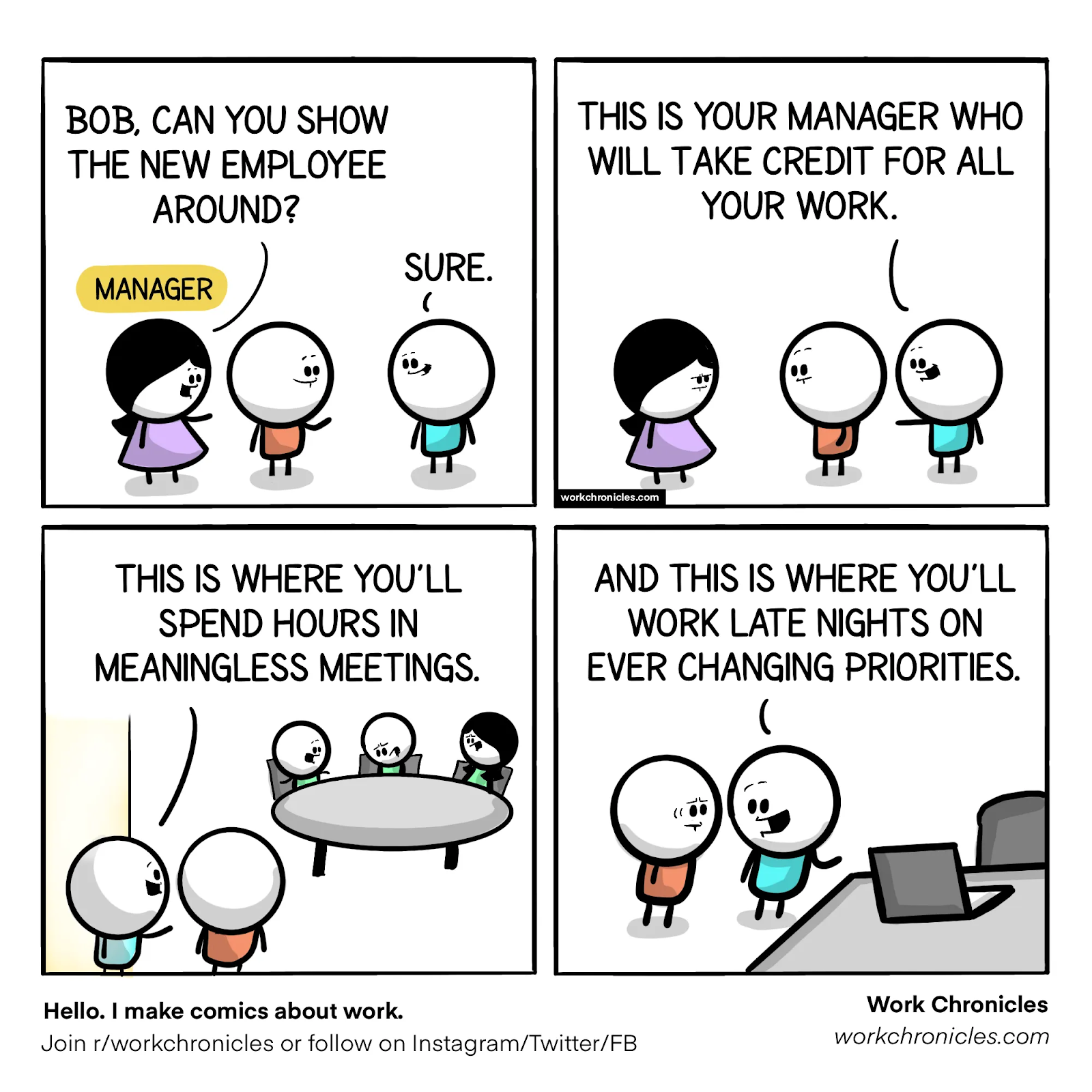
THIS IS YOUR MANAGER WHO 
BOB, CAN YOU SHOW 
WILL TAKE CREDIT FOR ALL 
THE NEW EMPLOYEE 
YOUR WORK. 
AROUND? 
SURE. 
(YAN G 
e 99 
workchronicles.com 
AND THIS IS WHERE YOU'LL 
THIS IS WHERE YOU'LL 
WORK LATE NIGHTS ON 
SPEND HOURS IN 
EVER CHANGING PRIORITIES. 
99 
Hello. I make comics about work. 
Join r/workchronicles or follow on Instagram/Twitter/FB 
Work Chronicles 
workchronic/es.com

Bonus: New Starter Packs

When I started, I think all I got was a writing pad to make notes. Maybe I got a pen.

Years later – existing staff, and all new staff were also given a water bottle, and a company-branded hot drinks flask. Even though it’s a simple thing, everyone seemed to appreciate it.

More recently, it was announced that “New Starter Packs” would be posted out to all new starters, and we were asked for feedback on the contents. I don’t get why they didn’t anticipate some backlash because they only planned on giving them to new starters. Also, they clearly had already ordered a certain level of stock because they were taking photos of them and had quite a few company-branded items.

There were the obvious choices of pen, paper, post-it notes, drinks bottle, in addition to some chocolates, sweets and some other miscellaneous items.

“The new starters will be there with their fancy laptops, new starter kit, and high wages, laughing at us”

Me

Some people criticised the choice of unhealthy treats, given some recent schemes to promote healthy lifestyles. There was also a Webcam Cover you could put on your laptop, which someone questioned if our IT department had approved it – to which the Head of IT said they weren’t authorised because they “crack screens and they also damage the bezel of other laptops when removed.”

It was also only for staff based in England, but a high percentage of staff are now based in India, so the managers admitted we need to find a supplier over there too to be fair.

So it wasn’t a well thought out idea really.

Software Development Process

When a new development team is created, managers insist on creating a “Ways of Working” which essentially comes down to describing the software development and testing process in the ideal way.

Then after a few weeks, you end up just resorting to the default way of working.

The “ideal” way assumes that the Testers can provide ideas and inspiration to the Developer, and when the Developer writes the fix, the solution won’t deviate from their original perception. Therefore, all the Test Cases are written up front, and none are needed to be written after.

Here is an example that one of my former teams came up with:

Before fixing the defect

Analyse together 

  • Make sure you pair up as a developer and tester to work on the defect.
  • Review the problem together
  • Understand how to replicate the fault
  • Understand the extent of the problem (all regions, all set-ups, all environments?)
  • Do the initial debugging to understand where the problem lies

Fixing the defect

The developer MUST 

  • Make sure there are unit tests to support the current functionality
  • If there aren’t unit tests then implement a simple refactor which will allow appropriate unit tests to be added
  • Add unit tests that prove the defect (which will fail)
  • Fix the defect
  • Get it code reviewed
  • If you are working on code you are not familiar with, get 2 reviews, one of which must be from an expert
  • Run all the unit tests and prove the fix

The tester MUST 

        • Write test cases with steps and expected results for the initial test cases. They must

                ○ Be clear and unambiguous

                ○ Cover the different scenarios/circumstances/options

                ○ Not test things that are irrelevant

        • Once written, set the state to “Review” and assign to the reviewer

        • The reviewer

                ○ Adds comments as appropriate

                ○ Set the state to “Ready” if Ok, or back to “Design” if it needs changes

                ○ Assign it back the test author

        • Only use Given, When, Then if you are using Specflow to automate your tests

        • Only use exploratory testing

                ○ If you have passed a Rapid Testing course

                ○ And you have a clear understanding of testing heuristics

                ○ And you plan and classify sessions, keep session logs, run debriefs

                ○ And all the specific test cases and all regression test cases have been executed

        • Create regression tests of the functionality

        • Create test case(s) to prove the defect

        • Get the tests reviewed

        • If you are working on functionality you are not familiar with, get 2 reviews, one must be from an expert

Assure the Quality

  • Review the actual changes together
  • Understand the logic
  • Understand the scope
    • Minor/contained (inside a method that’s inside a class that doesn’t affect anything that’s outside it)
    • Medium/impacting (a change that impacts outside it’s own class or is called from elsewhere in the system
    • Major/widespread (a complete refactoring of existing code or large changes to core features)
    • If they don’t understand the logic or can’t establish the scope, escalate to the Technical Manager
  • Execute the tests
  • Attach and link all work items and evidence together

How Software Bugs are Prioritised

A Product Manager recently wrote about how Software Bugs aka Problems are prioritised, so I thought I’d share that here.

Prioritisation Spotlight Report 

Product Managers conduct a weekly meeting with other stakeholders to discuss Problems and their effects on our customers. A key output of this meeting is to ensure that we are prioritising the defects that are causing our customers pain or have the ability to do so. 

These Problems can range from being the result of a major incident, recent software upgrades, or internal database monitoring. However, what they share is that they all have the ability to generate customer dissatisfaction. 

The Product Managers have been ensuring we are able to accurately and consistently apply logic to the Prioritisation process. This is a key requirement of the Problem review that allows us to create the prioritisation for Development to work on. 

How does this work? 

The weekly Problem Prioritisation meeting is open to anyone who has a business interest in resolving these software defects for our customers. When discussing these defects as a group, a number of areas are covered, some of the new key areas are below:

Number of cases linked to Problem – this is multiplied by 2 so a Problem with 4 cases will generate a score of 8 for example 

CSAT (Customer Satisfaction score)– This is the level of market impact the defect has, or is expected to have, and is scored in 4 areas; Critical, High, Medium, Low. 

Software upgrade blocker – Does this hold up the ability to patch customers to a newer version of the software

Safety rating – Does this have safety implications? 

The Prioritisation reason – has the problem been raised as an internal escalation,  safety, Information Governance, Security, Customer pain/Escalation, Service Level Agreement, or an Enhancement via the User Defined Roadmap. 

IG – Does this have Information Governance implications? 

Number of users impacted – taken into account based on how widespread the issue is and how many customers are affected. 

What will this allow us to do? 

This is going to help us all become aligned with the vision across the different areas of the business and will enable key stakeholders access to a single source of truth when scoping these items into the team’s backlog. A “Top 100 Problems” list will be updated after the weekly meetings.

Software Tech Jargon

When you work in the Software Industry, it’s obvious there’s going to be a lot of technical terms and abbreviations/initialisations. However, I think in many cases, you could easily write/say something in a way that more people could understand. I think sometimes people want to appear more technical, or maybe even “gatekeep” by trying to outnerd their peers. Over a long period of time, I have collected various written and spoken quotes. So here is a nice and varied collection. I don’t understand what many of these mean.

“I believe this to could be because of the contiguous memory necessary to rasterise an image of this scope.”

“I think if you are migrating the symbol server, then you need to consume the symbols”

.Net Nerd

“That’s why I use a View that bakes the invariants in so I don’t need to re-check them a number of times.

Adding this index could improve performance of the query by 47% and avoid using hash matches and parallelism operators.

DB Nerd

You have a couple of options here. 1. If the data is small then you might consider xcom as an intermediary to share data between two operators. Preferably this is up to hundreds of records and no further (without using custom xcom backends). 2. Sounds like you probably want something like a TrinoToCloudWatchMetricsOperator, it’s the sort of thing that would need to be implemented as it’s quite niche but could likely be re-used across teams. I tend to treat Python Operator as a fallback option now. If it really doesn’t make sense to write your own operator because it’s so specific and couldn’t be re-used.

 This code will need to be changed at some point in the future to detect the Evergreen Runtime as a prerequisite – removing the need for this Visual C++ runtime check.

For anyone interested in learning about Node.js and the MEAN stack to produce a quick REST API, this is a pretty good tutorial which dockerises the app too and deploys it to aws: https://blog.codeship.com/running-mean-web-application-doc…/ Incorporating a CI system like Travis, Jenkins or Circle, testing with Supertest or Postman and adding in aws clusters and load balancers means in a very short time you can create a CD system for the API too with a time to live of 3 to 4 minutes. Using all free tools like VS Code, Github and the AWS free tier means it can all be done without paying a single penny too. too much

Me 13:27:
can you tell me how a minimal deterministic acyclic finite state automaton would use less space than a trie?
Lucy 13:29:
7
Me 13:30:
This is because a DAFSA can compress identical branches from the trie which correspond to the same suffixes (or parts) of different words being stored.

what kind of nerd do you have to be to understand all this jargon?

The user account is in a different forest than the computer account. The processing of Group Policy from another forest is not allowed. Group Policy will be processed using Loopback Replace mode. The scope of the user policy settings will be determined by the location of the computer object in Active Directory. The settings will be acquired from the User Configuration of these policies. 

Windows Event Viewer.
now that is a good bit of jargon. What the hell is a forest?
This is from some jargon from FutureShop for some crazily expensive headphones.

The LCD-4, Audeze’s new reference headphone, is the result of dedicated research and development and advancements in materials science. It features Their amazingly thin nano-grade diaphragms and unique Double Fluxor magnet arrays for the most powerful magnetic flux density in existence, an incredible 1.5 Tesla! It also features a new comfortable suspension-type carbon fiber and leather headband and delivers breathtaking high resolution sound, imaging and transparency, with exciting dynamics.  

We are pleased to offer a free cable burn-in service for this cable when purchased through us. The Nordost VIDAR cable burn-in machine combines three different functions all in one operation:
It neutralises charges that build up around the cables and the insulation 
It provides a very wide band and deep conditioning into the conductor core, which produces changes in the way signals pass through the metal. 
It ultrasonically conditions the surface of the conductors.  

 So, we’ve now got a requirement to orchestrate some containers with Kubernetes and patch some MS SQL databases. Now we can bring Octopus in because we no longer have 180,000 machines to deal with, just the 300 or so database boxes with Kubernetes managing the rest of the servers running the containers. Throw in your CI/CD tool of choice to pipe directly in to Octopus and your container registry and you’ve got a pretty sweet setup going!

Me 16:30:
Enablers support the activities needed to extend the Architectural Runway
have you tried extending the Architectural Runway ?
Andrew  16:32:
i think there were protests about them doing that

Append blobs are made up of blocks like the block blobs, but are optimized for append operations. These are used for things like logging information to the same blob from multiple VMs.

https://docs.microsoft.com/en-us/azure/storage/common/storage-introduction

Suppress OrganisationLookup Index queries from the ambient transaction so that upstream callers can run their own transactions without escalating to a distributed transaction.

DB Nerd

The transaction log for database ‘tempdb’ is full due to ‘NOTHING’.

SQL Server error

Ongoing issues with L drive, so it has been recommended that we change the 10% buffer to 20% buffer. so the job stops earlier, but has less impact to live service and easier to support the job and provides more headroom if necessary. Will have an impact on how long the job to run.

“The StringFormat::GenericTypographic method creates a generic, typographic StringFormat object.”

Microsoft docs. I wanted to know what StringFormat.GenericTypographic actually does. Still non-the-wiser

 It comes bundled with a few really interesting tools developed by the CoreOS team, such as etcd, fleet, and flannel.

most organizations seem to be quite attached to an antediluvian model of testing all components in unison. We had two services on the backend — a gevent based API server and some asynchronous Python background workers which had a tangle of gnarly native dependencies including the C++ boost library which, if memory serves me right, was compiled from scratch every time a new Vagrant box got spun up

If you’re an Erlangista, you’re probably familiar with Fred Hébert’s manual on using the Erlang VM’s primitives to debug production systems while they are running. Languages like Go come with built in support for obtaining the heap, mutex, CPU and goroutine profiles of any running Go process Unit testing such service-critical I/O with mocks inherently embodies a sellout since it not just sacrifices accuracy at the altar of speed, but also ends up shaping our mental model in a way that’s almost entirely dissonant with the actual characteristics of the system we’re building.

Some good words thrown about in this blog: https://medium.com/@copyconstruct/testing-microservices-the-sane-way-9bb31d158c16
Me 11:35: 
have you heard of a kibibyte

Daniel 11:35: 
nope

Me 11:35:  
any serious programer know the difference between kilo and kibi... – Florian Peschka 

apparently its 1024 bytes whereas a kilobyte is 1000

In computing, a nibble (often nybble or nyble to match the vowels of byte) is a four-bit aggregation,[1] or half an octet. It is also known as half-byte[2] or tetrade.[3] 

Moreover, 1982 documentation for the Integrated Woz Machine refers consistently to an “8 bit nibble”

Wikipedia
Me 15:41: 
one day I'm gonna work out what Memoize() does and use it
Andrew 15:42: 
What is memoization and how can I use it in Python? 
if you don't know what it is then don't bother trying to use it
end of
Me 15:42: 
it sounds like a great word
"such as in simple mutually recursive descent parsing[1] in a general top-down parsing algorithm[2][3] that accommodates ambiguity and left recursion in polynomial time and space" 
Andrew 15:43: 
haha that's gotta be some sort of joke
Me 15:43: 
It says "simple" so it must be. You just aren't smart enough"Me 15:41: 
one day I'm gonna work out what Memoize() does and use it

I’d like to use NodeJS NPM package manager to setup a small gatling/postma/newman box for REST API testing. However NPM seems to have a problem with the corporate proxy. Does anyone have any tips for making the installation process easier?

Developer

“Before you can deploy Helm in an RBAC-enabled AKS cluster, you need a service account and role binding for the Tiller service.”

“making it volatile means it chucks out the thread-cached value for the variable each time it’s read. Therefore getting the actual value each time” 

Developer

The KeyStore Web Services 8.1 uses a contract first approach to web service development. This approach defines the message contract for each web method requests and responses up front using xsd schemas and WSDL. This allows KeyStore to establish a suite of fixed web service methods that can be managed and versioned between releases.  

Hierarchical xml messages are constructed using xsd type definitions in order to establish a request and response message for each web method. When referenced using tools such as visual studio .Net, this will create a client side proxy classes that developers can use to call the web methods.  These proxy classes represent a strongly-typed client side object class model for each method request and its response. This removes the need for web service clients to work with raw xml. It also has the added advantage of ensuring type-safety for many input parameters (e.g. Dates/Integers etc).

“STAThreadAttribute indicates that the COM threading model for the application is single-threaded apartment.”

Available now: Single-threaded apartment (fully-furnished)

Andrew with a joke

For Gafana those who want to use the dashboard I created the JSON attached just needs to copied into import for your local Gafana ,Can someone try this I am interested to see how ‘intelligent’ Gafana is and if it exports the Data Sources it should be looking for as well or if the user importing needs to get them up as well

We have a CIS hardened ubuntu image with ssm access as a base image. I have installed all my software dependency and then made it as an ami release image. When i use this new ami image as launch template and create ec2 instance i can’t able to connect ssm. I have enabled ssh connection and check the status of ssm it is enabled & running.

Developer question. Can you help him?

 I’m trying to create an Alias and a CMK key and trying to associate the alias with a secret. I was getting the following error during deployment using CDK “The operation failed because of an invalid KMS key: Alias arn:aws:kms:eu-west-2:xxxx:alias/rejs-alias-int-secret is not found”. I tried to directly associate the CMK key instead of the alias with the secret and it is working fine. I have also tried associating the alias of the same CMK key with other resources like s3 and it is working fine in that case too. I’m facing issue only with the secret and CMK alias combination. Am I missing out anything here? TIA

Developer question. Can you help him?

I’ve added some instrumentation to the FireInternal method on the EventBroker class to include the eventid in the exception message so we can try and identify where the null event is originating from. Going forward, maybe we should replace the .net 2 lock, queue approach with the ConcurrentQueue class in .net 4 to try and prevent any possible cross threaded operations / race conditions on the eventbroker. It looks like this issue isn’t just occurring on the quick access toolbar select patient operation but also on SessionControllers._messageReceivedWorker_DoWork method.

Developer

Kafka™ is used for building real-time data pipelines and streaming apps. It is horizontally scalable, fault-tolerant, wicked fast, and runs in production in thousands of companies. This can be done in a round-robin fashion simply to balance load or it can be done according to some semantic partition function

Likewise for streaming data pipelines the combination of subscription to real-time events make it possible to use Kafka for very low-latency pipelines; but the ability to store data reliably make it possible to use it for critical data where the delivery of data must be guaranteed or for integration with offline systems that load data only periodically or may go down for extended periods of time for maintenance. The stream processing facilities make it possible to transform data as it arrives.

https://thirdeyedata.io/apache-kafka/

–parallel

Similar to –stream, but completely disregards concurrency and topological sorting, running a given command or script immediately in all matching packages with prefixed streaming output. This is the preferred flag for long-running processes such as npm run watch run over many packages.

$ lerna run watch –parallel

Note: It is advised to constrain the scope of this command when using the –parallel flag, as spawning dozens of subprocesses may be harmful to your shell’s equanimity (or maximum file descriptor limit, for example).

Lerna

In parallel computing, an embarrassingly parallel workload or problem (also called embarrassingly parallelizable, perfectly parallel, delightfully parallel or pleasingly parallel) is one where little or no effort is needed to separate the problem into a number of parallel tasks.[1] This is often the case where there is little or no dependency or need for communication between those parallel tasks, or for results between them.[2]

Thus, these are different from distributed computing problems that need communication between tasks, especially communication of intermediate results. They are easy to perform on server farms which lack the special infrastructure used in a true supercomputer cluster. They are thus well suited to large, Internet-based volunteer computing platforms such as BOINC, and do not suffer from parallel slowdown. The opposite of embarrassingly parallel problems are inherently serial problems, which cannot be parallelized at all.

A common example of an embarrassingly parallel problem is 3D video rendering handled by a graphics processing unit, where each frame (forward method) or pixel (ray tracing method) can be handled with no interdependency.[3] Some forms of password cracking are another embarrassingly parallel task that is easily distributed on central processing units, CPU cores, or clusters.

https://en.wikipedia.org/wiki/Embarrassingly_parallel

Not gone to production

We recently had a Development department meeting. One person raised a point about the recent higher-than-normal staff turnover, and also commented on the number of cancelled projects:

“If we look at Group Technology that I’m part of as an example, a lot of our staff turnover can be attributed to problems specific to the department and specific to development work: onerous manual, slow processes, moving from one cancelled product / project to another etc.. Some developers have been working here years and never worked on anything that has actually got to the customers for example. How do we propose to tackle those specific culture problems?”

I thought it was funny, because I knew one particular developer who had worked on a small cancelled project, then worked on – what was supposed to be – a replacement for our flagship software. Then when that project got restarted, he moved back to our flagship product on what was supposed to be the most important project; which also got canned.

Andy Marsden 16:18
i just love free shares
we got 50 last year, basically like £600 for nothing

Me 16:18
Our wage is basically for nothing
remember that time your code went to production?

Andy Marsden 16:19
no
is it just me that doesn't care about who uses my code?
i just like writing code

Me 16:19
Andy is writing code for the terrorists

Andy Marsden 16:20
haha
seen something before that's like a moral question:
"As a developer, if an oppressive government took over and forced you to write code to destroy Paris for example, would you write it flexibly so that it could be used to destroy any city?"
i couldn't bring myself to do it (write rigid code that only destroys Paris)

At the start of last year, the CEO had made a big fuss about a Scotland project that needed doing by Jan 2023, so many of our best staff members were assigned to it and were told not to help out with any other requests. As it got closer to the end of the year, there were discussions to cancel it, and eventually it was canned. You are talking approximately 30 staff members and paying them for a year of work. Completely binned off. Well, they said it had been shelved until our new software is released, but given that it has been in development since around 2018, is that ever going to be finished?

The Phantom Bogey Wiper & Sub-human Antics

I was looking through my work emails, looking for some classic stories, and found the story of The Phantom Bogey Wiper.

From: Lee Davidson
Sent: 10 May 2010 14:42
To: Development
Subject: If you're the phantom bogie wiper please take note!!!
Importance: High
 
Apologies to everyone for my tone in this email but some filthy scummy piece of excrement who’s most likely one of our colleagues has been wiping bogies on the toilet walls.  This isn’t something that happens by accident, the offending vile contemptible excuse for a human being must be making a conscious decision to offend others so I’ll not hold back in my show of disgust at this utterly pathetic person. 
 
Whoever you are and you know who you are could you put a stop to it please?
 
Regards,
 
Dave. 
From: Lee Davidson
Sent: 27 May 2012 10:26
To: Development
Subject: Toilet etiquette

Dear Colleague,

It is with great deal of regret I send this message but the sub-human antics of one or more of my male colleagues in confines of a toilet cubical have left me appalled and disgusted.

I can’t believe I’m typing this but could the person who is treating the toilet as their own personal cesspit please use the following etiquette.

·        Do not wipe your bogeys on the cubicle wall.
·        Do not spit chewed toilet paper on the toilet door.
·        And worse of all do not smear your excrement on the cubicle wall.

If you’re the person responsible then please remember you share this toilet with civilised human beings.

Best Regards,
David.
Lee Davidson
From: Richard Hirst
Sent: 29 March 2012 10:36
To: Keith Hanrahan; Me
Subject: FW: Toilet etiquette

Stay vigilant people… The toilet related incidents have been much better upstairs since Testing moved downstairs, any suspects?

From: Me
Sent: 29 March 2012 10:40
To: Keith Hanrahan; Richard Hirst
Subject: RE: Toilet etiquette

Ben always said he had poor hand-eye co-ordination. Maybe bum-hand co-ordination too

I can’t believe I wrote that in an email. I don’t think we had chat apps back then though. I shared it with a colleague:

Sadiq Khan: 
In this day and age, that's a ballsy email

Me  09:15
11 years ago :scream:

Sadiq Khan  09:16
Makes sense for that time

Me  09:17
back in the dark ages where we wiped poo on the walls
From: Scott Simpson
Sent: 27 August 2015 13:19
To: Development
Subject: Toilet etiquette


Apologies to all the female members but having to send the below out again!! Credits to Lee Davidson for the initial email 3 years ago.

I have added a slight addition after a harrowing experience yesterday!
·        Do not leave your excrement all over the toilet seat or around the bowl – It is NOT the cleaners job to clean after you!

Scott Simpson
Product Owner
From: Norman Taylor
Sent: 24 November 2015 10:16
To: Development
Subject: RE: Toilet etiquette

Apologies once again to all the female recipients of this email!

I’d just like to reiterate Scott’s point below as I’ve spotted a second sighting of this in the downstairs loos! :/ Not exactly what I wanted to see after my morning porridge!

Norman Taylor
From: Mike Dean
Sent: 24 November 2015 10:18
To: Norman Taylor
Subject: RE: Toilet etiquette

That’s probably nothing compared to the state of the left-hand cubicle toilet seat yesterday afternoon, mate!

I had to force the contents of my lunch back into my stomach!
June 2016

Me 16:40: 
The Phantom Bogey-Wiper has been hard at work. There's a right collection in the toilet cubicle wall 
surely, there's not many people who it could be, unless there's more than one Phantom

Mike Dean 16:42: 
the phaaaantom of the loo-pera is here
disgusting

Me 16:45: 
in fact, the original incident that you sent me was 10 May 2010  
so 6 years on, the Phantom is still at work

Mike Dean 16:47: 
wow
who could it be?
I've been here about 6 years, but I have an alibi

Me 16:48: 
if it's the same person, they must have worked in those 3 offices, must be male, and in Development
but there could be multiple phantoms

We never did solve the mystery. I did suspect it was multiple people but quite hard to accept people would behave in that manner.

Can AI Make Computer Games?

Jabrils created a game using various AI tools. Although he says it was 100% created by an AI, it required him to type in different prompts until he got something that worked, and needed to use different AI’s in order to get the code, images, and sound. So it still needs human input as a “director”.

I fooled an expert gamedev with a game made ENTIRELY by AI

He got David Jaffe, who worked on the likes of Twisted Metal and God of War, to harshly critique it, oblivious to the fact it wasn’t Jabril’s own game.

He initially struggles to work out what the aim of the game is, which highlights the fact that – even though it is a working game – it doesn’t have the extra polish such as a tutorial, button prompts, or subtle visual hints. Although, maybe it could have added them had Jabrils specifically asked for those features.

“I have no clue what I’m doing in this game. If I wasn’t recording this video with you – I would be done”

David Jaffe

“I also don’t know what my goal is. I assume it’s to land but you don’t really have the space marked very well.”

David Jaffe

Since David believes that Jabrils made it, he remarks on how you think your own game is obvious how to play it, but that’s why getting someone independent to play test your game is so valuable. It’s similar to any type of software development really; you can be so focussed on coding, that you don’t see the bigger picture and the various ways someone can interact with it

After he is told it was made by an AI, he becomes more positive. 

“I think it is brilliant. Looking at it from that perspective, that is how games are going to get made more and more, right. The fact that you could do that, and say ‘make me a game that does X, Y and Z’ is amazing…I love it. I love that you made this. It’s terrible, but it’s kind of like criticising a one-year-old who took his first steps.” 

David Jaffe

It’s going to be interesting how AI develops, and I do wonder how long it will be before human interaction will be reduced, and also if AI can “understand” game design to actually incorporate more user-friendly features.

Employee of Choice: Culture

Intro

Last year, my employer announced an “Employee of Choice” scheme. It wasn’t clear if this was an official award or a self-awarded title. Essentially, they want to improve a few key aspects so that current employees would recommend working here.

I had previously written about the survey and the results.

There were a few key pillars: Culture, Leadership, Employee Rewards and Terms, Work Environment, Processes, and Branding. Many people were sceptical that there would be any meaningful improvements.

Discussion

I discussed the topic of Culture with a few colleagues. The discussion was triggered by me saying that: I was intrigued what they would come up with to improve culture – since the term is a vague concept. Is “culture” just a naturally-occurring subconscious thing that happens? Or is it something you consciously try to create?

One colleague said he perceived it to be more about the working environment. People always loved the job despite the lower comparative wages because of the perceived positive culture. He said most people worked closely, and that meant people went from colleagues to friends. The “breakout” room, where people can go have a break or have lunch, encourages people to talk as friends. The addition of the canteen had similar benefits and gave a great option to purchase good food. The office was located near a park which was also great to go for a lunchtime walk. So it seems his perception is about how you perceive your colleagues and your ability to relax.

However, he said now we work at home “All those have gone. All that’s left is the work friends but it is diluted.” (many have since left and you don’t get to see the remaining people without a lot of effort.)

Another colleague said “it’s hard to change the culture because it’s so ingrained“, which sounds like it’s more like emergent behaviour.

Culture Manager

After a few months, we heard from the manager who is leading the “Culture pillar”. He admitted that he has actually been thinking of what “culture” actually means. I think it might have been helpful for him to question that on Day 1, rather than after a few months. Better late than never, I suppose.

You hear about “toxic” cultures, and sometimes about inspiring cultures (sometimes you just hear of positive aspects of the big tech companies, like Google having a slide for a bit of fun). Culture is not a tangible thing like an employee benefit – culture is something that only lives in our heads.

Culture Manager

He goes on to say that what people perceive to be “culture” is “hard to quantify, evidence and even explain“. Some people may write it off as “corporate jargon“, yet others deem it as important. Since it can mean different things to different people, how can he even begin to improve it?

I guess another point is: if we did a survey scoring the culture, and people have wildly different interpretations – then how do you even interpret a rating out of 5, and can you trust it at all?

He then ends the post by asking us what we interpret as culture? but also shifts the perceived poor culture onto the general staff by saying

a positive and progressive culture is on us as individuals – our culture is what we make it and believe it to be.

Culture Manager

We were told that the managers of each of these key pillars of the “Employee of Choice” have been busy making meaningful changes, but this post really sounds like: after months of work, the Culture Manager has decided he has nothing to do; and if there is a poor culture – it is our fault.

Employee Responses

A few employees responded to his post.

“Culture is the sum of a number of things which are driven by actions and good decisions, both individually and also from managers. Individuals have to all travel in the same, right direction and leaders and managers have to set the direction clearly and drive everyone towards it.” 

Employee

Another employee stated that managers put the onus on individuals by reiterating the company’s “values”, but culture is mainly driven from the managers showing those values:

“The company’s values represent its ambition to have a positive culture, but don’t do much to enable it on their own. Even if individual employees want to behave in ways that represent those values, corporate culture has a lot of momentum which is almost impossible for individuals to affect much unless they’re in a position of power.”

Employee 2

I liked those 2 responses, because they are basically telling the Culture Manager “YOU ARE WRONG!”

Another gave a more modern, woke response:

“To me, a good, progressive and welcoming culture should be inclusive and celebrate diversity (of individuals, ideas and ways of working)”.

Employee 3

Jessie Marsch’s Spieler Rat

I came across the following quote from ex-Leeds United manager Jessie Marsch. 

Note: The “fine system” he mentions is when players have to pay a monetary fine for breaking some rule. Some of the rules can be humorous (wearing flip-flops in the shower) but others are important aspects like not being late to training. The fine system can set the standard for professionalism but also allow for a bit of fun too.

“I have a leadership council everywhere I go. In Germany it’s called the Spieler Rat, the leader group. I ask them things like, how do we want to travel? What do we want to wear? Have them make the fine system, you know. But then I go deeper. What do they think of our tactics? You know, I ask them about match plans. I’ll ask them about training, about video, about everything. And I want them to be fully engaged at all moments. And typically, if a player comes to me and has something important that he believes in, then I will almost always include it in what we do, almost always. Because if I really am asking them to commit themselves, and give of themselves, then I have to give room for that to take place. I mean, I could give you a lot of different examples of that.”

He is talking about his leadership style which I think sets the scene to what the culture is under his management. You could manage as an authoritarian or be more open like a democracy. It sounds like the greater vision is provided by Jessie, but instead of micro-managing, he delegates that to his leadership group. I think his approach will make the players feel valued and more open to contribute ideas.

Conclusion

I still think Culture is quite hard to define, but it does seem like it’s the collective mood; driven by managerial decisions, and the physical environment employees are in.


Bug: Identification number mismatch

Recently, a developer had fixed a bug with title similar to “Tax Number is not populating in Save Registration dialog”

The original code looked like this:

public CarIdentification CarIdentification1
{
   get { return _carIdentification1; }
}
 
public CarIdentification CarIdentification2
{
   get { return _carIdentification2; }
}

if (!string.IsNullOrEmpty(transaction.TaxNumber))
{
   _carIdentification1.Value = transaction.TaxNumber;
}
 
if (!string.IsNullOrEmpty(transaction.RegistrationNumber))
{
   _carIdentification1.Value = transaction.RegistrationNumber;
}
 
if (!string.IsNullOrEmpty(transaction.NewRegistrationNumber))
{
   _carIdentification1.Value = transaction.NewRegistrationNumber;
}
 
if (!string.IsNullOrEmpty(transaction.NewTaxNumber))
{
   _carIdentification2.Value = transaction.NewTaxNumber;
}

So a quick glance at the code and you see that 3 of the 4 statements are using “_carIdentification1” then the last one sets _carIdentification2. So without putting much thought into this, I would expect one of the first 3 should actually be using _carIdentification2. But what does 1 or 2 actually mean? Are they representing TaxNumber and RegistrationNumber, or is it representing Old and New?

If it is the former, I think _carIdentification2 would represent TaxNumber so the first one was wrong.

If the latter, then I think _carIdentification2 would represent New so the third one is wrong.

I do know that the concept of TaxNumber was added into the system later on, so most likely it would be: “_carIdentification2 would represent TaxNumber”

However, the developer, Govind had changed it to the following:

public CarIdentification CarIdentification1
{
get { return _taxNumber; }
}
 
public CarIdentification CarIdentification2
{
get { return _registrationNumber; }
}
if (!string.IsNullOrEmpty(transaction.TaxNumber))
{
   _taxNumber.Value = transaction.TaxNumber;
}
 
if (!string.IsNullOrEmpty(transaction.RegistrationNumber))
{
   _registrationNumber.Value = transaction.RegistrationNumber;
}
 
if (!string.IsNullOrEmpty(transaction.NewRegistrationNumber))
{
   _registrationNumber.Value = transaction.NewRegistrationNumber;
}
 
if (!string.IsNullOrEmpty(transaction.NewTaxNumber))
{
   _taxNumber.Value = transaction.NewTaxNumber;
}

So they have named the fields _taxNumber and _registrationNumber which is much clearer. Notice though that they have deemed carIdentification1 to be _taxNumber which means they are saying the second, third, and fourth statements were wrong!

An additional thought: if a “transaction” comes into the system, what fields do you expect populated? if RegistrationNumber and NewRegistrationNumber are populated, then _registrationNumber will initially be set to RegistrationNumber, then instantly changed to NewRegistrationNumber! So I’d say this logic needs to be if/else so it only sets _registrationNumber once and _taxNumber once.

I point this out to the developer, but I find a large number of Indian developers just seem to respond with a sequence of meaningless words and you have no idea what they are thinking.

Me:

if NewTaxNumber and TaxNumber are specified, won't it just use NewTaxNumber?


Govind:

taxNumber identifier has to updated with new taxNumber value for transactions


Me:

if it is intentionally written this way, it should be if/else

and if it wasn't intended that way, then there is a bug here, similar to the one you are fixing

They ignored me and checked it in. I don’t know if just the original code was mad, or if this new code is mad too. Let’s hope it doesn’t cause more problems when it goes live.