What Is A Programmer’s Life Like?

I was listening to Fredrik Christenson’s podcast “My Life As A Programmer” and he was answering the question “What is a programmer’s life like?”.

I did wonder what the person who asked the question expected to hear. Did he expect a millionaire lifestyle or something?

Fredrik began by answering the question by describing a simple day: Stand Up update (progress update with your team); picking up new work; helping coworkers; maybe some meetings scattered throughout the day; but rest of the time coding. He then mentioned how programmers are just normal people and live normal lives and most people wouldn’t be able to tell a programmer by talking to them.

I do recall a time where I’d finished playing 5-a-side football and my friend then said how I must be really different compared to the rest of my colleagues. I looked at him a bit confused and said “what do you mean?” and he said “well, you play sports, I bet everyone else doesn’t”.

It seems he was just thinking in stereotypes. There’s loads of developers that I work with that are into fitness. There’s some weightlifting enthusiasts, some play Badminton, some play Football, one plays American Football, a couple of people play Field Hockey. There’s plenty of people that are into jogging, and a group of people routinely went jogging every lunch time.

There are definitely a few people that do conform to stereotypes but I reckon there’s more Software Testers that conform to that than Software Developers. So you do get socially awkward types, but there’s plenty of people that are just ordinary people.

Name and Shame Emails

Don’t you hate it when you get an email stating that you haven’t followed a process correctly, but then everyone else that has also made the same mistake is listed in the “To” field of the email. So it’s basically “naming and shaming” everyone.

One particularly patronising work email I have received recently is the one where you haven’t submitted your timesheet. There’s massive screenshots of the website with red circles and arrows pointing at each button you need to click in order to submit it.

It’s so dumb because it only makes sense if you have NEVER submitted a timesheet: If you have submitted several weeks worth, then missed 1 week, why do you need step-by-step instructions of which buttons to click? You know what to do, all the email needs to say is that you have missed a week, and it should state the date that you missed.

However, out of the 3 times I have received such a patronising email, there was actually only 1 time where it was actually accurate. The other 2 occasions, I checked the timesheet and everything was showing as submitted. I can only assume what they did was prepare the email a few days prior to sending it. Then in the meantime, I had gone and filled it in. Either that, or maybe it was a bug in the software.

If you are basically going to criticise someone, at least you need to make sure it is accurate. Then it’s advisable not to make it known to everyone by sending mass mails.

On a related note, I received the following email today:

As you may be aware, all colleagues are required to complete the Data Security training annually. 
Our reports show that your training is still outstanding. 
The training needs to be completed by Friday 30 April at the very latest. A status report will be sent to the Directors on Wednesday 28 April.

I don’t recall seeing any previous email about it. Yes, it is supposed to be an annual thing, but surely I’m not supposed to create my own reminder – where is the autogenerated reminder? When I went to do the training, it was actually 1 year and 3 months since I did it last. So in my opinion, that’s their mistake but now I am receiving an email that tries to make me feel like it’s my fault. With only 8 working days to complete it, surely it’s possible there are some colleagues on annual leave during this time, in which case I’d imagine they will then have the Directors on their back.

Ironically, part of the training involved General Data Protection Regulation (GDPR). One of the examples of a failure was about sending emails with all the recipients in the “To” or “CC” field, rather than the “BCC”. It’s probably really relevant when sending external emails, rather than the internal email I received about the timesheet. Still, it made me smile, and I think the general principle applies that you shouldn’t receive unnecessary information about people.

“What interaction have you had with varied stakeholders?”

One of our apprentices said he needs to fill in an “evidence” piece which questions aspects he has experienced on the job. Since he has mainly been studying for exams and filling in forms, he hasn’t had much chance to actually do any real work. So he wanted me to help him come up with ideas of what he can write about.

I don’t think we have that much interaction with people outside the immediate team really, but it really depends on how you interpret the question. I guess this particular question is just about stakeholders which includes anyone with an “interest” in the software.

I always thought it was annoying when we got asked questions like this on appraisals; usually the focus being on people outside your team/department. It’s not part of our job really, since we have a hierarchy so you would just get your manager/team lead to either arrange a meeting, or perform the action on your behalf.

The key thing for developers is to raise questions about requirements with a Product Owner. So if the requirements aren’t clear, or your investigation has uncovered new information – then the solution isn’t as simple as people imagined it would be. Then you could then agree on changing the requirements with the Product Owner, or creating a new “work item” with the additional requirements to implement at a later time.

Maybe you would need to talk to an Architect to come up with an overall solution to a complex problem. 

Sometimes we email the UX team for UX designs or to ask the Technical Authors to write us a nice user-facing message to display in a dialog box.

Ideally, in a perfect world, these things would be alongside the requirements since you would think there would be a process before it comes to us. But we never really work like that.

In a recent project, the requirements were vague anyway. It was more like “Feature doesn’t work for certain users” …they want to select a Proxy user and that user’s details are sent in the message. So I made those changes but then you realise that they could want to use the feature, but maybe haven’t configured it correctly. So you need to tell the users. So I’ve put in a message box to tell the user certain config is missing from their user. I’ll need to get the Technical Authors to write the actual message. It should also be confirmed by the Product Owner that they want it to work like that.

A Tester then found another potential issue and suggested we add a default behaviour in a certain scenario, but that would be something the Product Owner decides. Do you want to switch the default, or do you want to just tell the user this method is invalid, and they have to manually switch to a different method? But then maybe we would want to ask the UX team what they think the user flow should be.

I guess the conclusion here is that it’s always hard to know exactly what the system should do. You end up having some requirements but then when you implement it/prototype it, then you realise that there are other scenarios that you should also take into account. So sometimes it is an iterative process: there is a bit of back and forth with the conversations between these stakeholders.

Unity Learn

Recently, I’ve been learning game development using the Unity game engine. Unity have made their learning platform “Unity Learn” free of charge since the start of lockdown.

The first learning pathway was very good, but the next one started off well, then seemed a bit of a random collection of lessons from various content authors. 

Some of the lessons are more about process, rather than writing code, and occasionally you are asked to submit something to demonstrate you have followed it. However, you could literally upload a blank file and it will accept it, so it is a bit pointless. Also, some of the file restrictions are a bit odd. On the challenge where you are supposed to research some ways of improving optimisation, you were asked to upload an image rather than a text document. 🤷

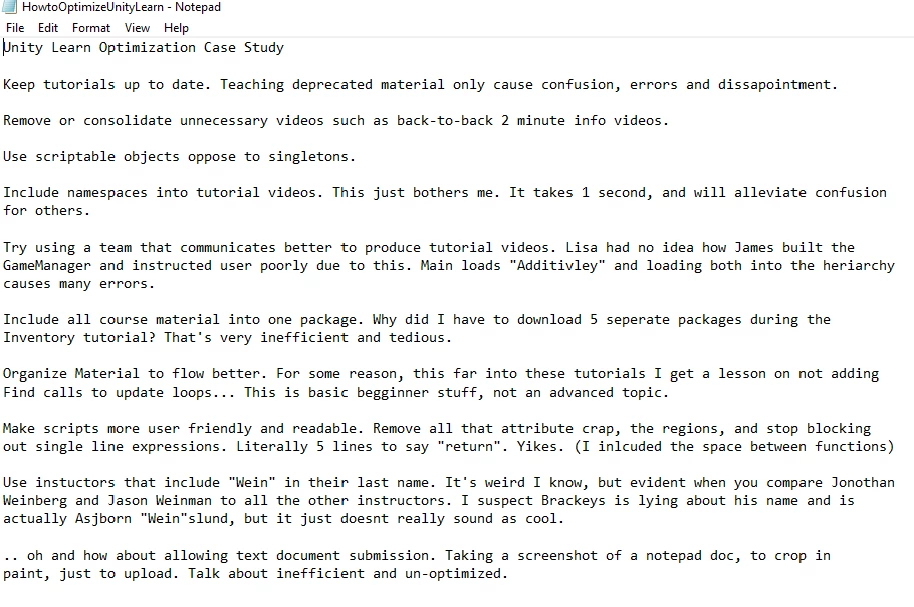
Once submission made me laugh, because it wasn’t about optimisation like Unity asked for, but instead, he gave a critique of Unity Learn.

He does make some good points, and I suppose most of these will only make sense if you follow the course. I’ve explained his final point though.

https://learn.unity.com/submission/60616140edbc2a2e6e4a24e5

I have watched quite a lot of Jason Wiemann and Brackeys. It’s a shame Brackeys stopped making videos though.

Shots Fired On Inexperience: Leaked Transcript

Intro

Even though all software developers should take part in code reviewing their peer’s code, I find most developers I work with aren’t that interested, so ultimately it comes down to a few high-ranking developers, plus me.

Recently, we have been rejecting a lot of bad code from inexperienced developers. It’s fine being inexperienced as long as you have a team to support you and help you eventually produce an effective solution. I think what happens is – there’s not enough seniors (or seniors that are actually good), so the code gets into their Project Branch. Then, when it is time to merge in for the Main release, experienced developers review the code and reject it.

I often specifically get asked by the Software Delivery managers to review code to ensure it is in a good state for the release. We had a group conversation where we were discussing the current bad state we are in. Software Delivery managers had asked Darren, Dave and me to review a project.

Participants

Darren, Dave – Principal Developers

Mark, Michelle – Software Delivery Manager

Me – the silent observer

I’ve given the developers names that start with D, and the managers names that start with M, so it might be easier to follow.

The Conversation

Darren  08:36

Whole lot of Nope in this Code Review.

Mark  10:52

Judging by your review comments, this doesn’t look to be something that can be resolved in the next couple of days. Does their implementation need to step back and restructure?

This might need another call

Have any of you guys been involved from a high level view for this Project?

Darren  10:55

The changes to the Database are totally inappropriate, and possibly way off the mark of what is needed.

Changes to the Database filing are non-trivial, if people don’t understand it, they need to reach out for help, not just smash code in.

Our product is going to turn into a legacy codebase very quickly if this behaviour carries on.

Dave  11:11

We do keep getting Code Reviews to Main with unworkable solutions. It’s highly frustrating, and a big waste of our time. Most of the time, the code or even the work item has not been reviewed by an expert-level person before a review to Main is requested. On occasion, someone gave correct advice in the first instance which was then ignored.

We need to fix this, and have help from you guys raising the problem.

Darren  11:14

The solutions feel like a very reactive approach to programming… Very little thought for design.

Mark  13:02

So have any of you guys been approached about this Project before this review  was raised?

Because I think this ties in with the whole idea of needing an Subject Matter Expert during the construction of the project rather than at the very end – something that we’re trying to drive forward

Dave  13:07

only about 2 days ago 😖

All our Subject Matter Experts are on the New product 😛

Darren  13:08

I reviewed the previous incarnation of it, without the concerning the Database changes.

“All our Subject Matter Experts are on the New product” Even so, I might have made time to discuss this with someone if asked.

Dave  13:09

yeah same

My point is that the day-to-day design and building of the projects is led by inexperienced devs. The developers are not being mentored while developing the code – but instead, at the end of their code writing; which should be something a lead developer is doing

It’s good to have the view throughout the dev process, or at least the start, as well as quality checks at the end – which should be a straight-forward “yeah, you’ve not done anything crazy, it meets the coding standards and is what we agreed”.

Mark  14:43

Yeah. This is all the good stuff which me and Michelle are trying to address as well. Trying to have a Subject Matter Expert assigned to each project during construction just for that overarching view, and to give a steer when needed.

I.e. a month ago this could have been caught at the start by saying “don’t make these changes within the Database itself” haha.

Darren  14:51

To be fair, you don’t need a Subject Matter Expert to tell someone not to dump a load of copy and pasted code from one module into another. Just someone with some experience in developing software to a higher standard than “Hello World”.

Michelle  14:52

“Hello world” just triggered some terrible school flashbacks.

Dave  14:52

Agreed, but as a business, we need Seniors to point out when people are constantly doing silly things to their line manager.

Michelle  14:57

It’s the experience aspect that is the biggest challenge, if there was a better ratio of experienced people to inexperienced people areas where skills are not good enough, they would start to improve (or at least that’s the theory).

Everything just seems stretched way too thinly at every turn. Hell, it isn’t just development that has the problem.

Darren  15:00

I’d also add: knowing anything about the teams working on the code would help.

I can’t know everyone, but I don’t even know what the teams are, what they are working on, who the seniors / leads are to discuss with.

E.g. if someone has a problem with code my team is doing, then I’d expect to be brought into the loop (either to explain our position, or to understand the other sides)

Dave  15:06

Who do we talk to, to at least pass the buck on the issue and raise it?

Michelle  15:11

I think it is more for the Development Director. It’s something me and Mark have brought in fashion everytime we come across an example. Difficulty has always been what to suggest to fix it within the limitations of what we got

Dave  15:21

Certain business types don’t understand the value of good engineers and will simply get the cheapest money can buy, in the hope the decent engineers will act as quality gates and stay with the company.

It must be soul-destroying, working away in an office across the globe, with ‘experts’ in the UK saying if your work can or can’t join the rest of the product. It’s not the right thing to do.

They need infrastructure mirroring ours, and separate projects would be a great way to achieve it

Darren  15:25

Last I knew, the other office still have Development and Testing as separate departments

Dave  15:25

This just reinforces the stereotype that Ben bangs on about: the company is ruled from the UK. Normal companies have different product sectors at different locations, because it mitigates these problems

Michelle  15:27

All valid points. What Dave is saying are points raised verbatim by more than a few people who have been in this world for a while. As for soul destroying: 100% agree it has to happen to catch this stuff; but each time it’s caught it will knock you back that little bit more

Just needs some kind of sensible structure that is adhered to. But then again – if no one is made to follow something, who will?

Dave  15:30

Yeah, for me, it’s responsibility, if you don’t have to pay for your actions, then it drives bad behaviour. But since we maintain our Product, having to pick up the bugs, see the customers complain on Social Media, see the error reports on live and backlogs grow, we’re a lot more invested

it is feeling more and more like, knock this feature out as quick as possible, throw it over the fence at UK law-enforcement, see if it goes through

👮

With responsibility you’re driven to get the right structure in place, you want to place experts/leads with the teams and have them monitor each day, because it soon becomes a very long task to get fixed last-minute. Top-down approach, drives the 9-5 job behaviour, lack of interest and minimum viable work ethic.

Darren  15:32

+1

Which goes back to my point about who the teams actually are. And we really need to do proper ownership. I still own large bits of our Product, because I care about them!

Dave  15:34

Same. Developing and code reviewing isn’t my job, really. However, I don’t want to see the product damaged and go to waste, because it helps people, genuinely.

Darren  15:34

Would be so much nicer to say “I don’t look after this any more, just do what you want and hope nobody gets sued” 😣

And it isn’t any one change that is unsafe, it is the poor quality, lack of adherence to existing designs, just piling code in, coupling stuff together, changes in the wrong place, etc that lead someone else to create a unsafe bug later – usually without anyone batting an eyelid.

OK, some changes are totally unsafe too – a few weeks ago, I have to point out that you cannot calculate an age in months by doing ageInYears * 12

😖

Dave  15:48

So, if I were to write some general comments without mentioning names, and send them to the Development Director, expressing that we’re at our wits-end, would anyone be prepared to back it up or be a part of the revolution?

Darren  15:50

Feel free to add my name to give clout to this

Dave  15:50

sure, I will of course send to you first to check

Summary

  1. Not enough people willing, or have the ability to review code. – I always find this a weird one; given that I reckon 90% of a developer’s job is reading existing code. If you cannot review code, then can you be a good developer?
  2. People aren’t putting enough thought into the architecture, or adhering to well-known standards like SOLID Principles – This is the kind of behaviour I saw in developers I’ve written about like Colin and Derek.
  3. The ratio of Juniors to Seniors is far too high, which not only is a problem now, it is a problem in the future when the Juniors haven’t progressed enough.
  4. The rapid hiring of staff has meant you don’t know who people are, what they are working on, and what their level of experience.
  5. Hiring cheap staff has caused some resentment/uncertainty with UK staff. Pay seems frozen and more jobs are moving abroad. It wouldn’t be that bad if the staff we hire are cheaper and are good, but they often just appear to be cheap.
  6. It would be better to split the offices into separate products so people feel like they have full ownership. There’s other problems too like time-zone differences and general communication problems.

More Bad/Weird Code

This is a follow on from my previous blog. I picked out a few examples that were bad changes from their Code Review, but maybe you didn’t think it was that bad in the grand scheme of things. So here is a collection of other weird stuff from the review.

Example 1: TrimEnd

TrimEnd method can be used to remove trailing whitespace, so if you have some text “Example text “, you can trim it down to “Example text”. You can also pass in an array of characters you want to remove from the end as well. So what happens if you create a completely empty array of characters?

return value.TrimEnd(new char[0]);

I had to test it out to see what it actually did. I was thinking there was a chance it could prevent the method from trimming anything at all. It actually does the same as TrimEnd() so removes whitespace only. So the char array is just redundant and looks confusing.

Example 2: The Weird “Any” check

Give a C# programmer a list called “textToProcess” and ask them to check if the list is Empty, and they will write this:

List<String> textToProcess = GetData();
return !textToProcess.Any();

or alternatively:

List<String> textToProcess = GetData();
return textToProcess.Count == 0;

But when you see this, then questions need to be asked.

List<String> textToProcess = GetData();
var empty = new List<string>();
return empty.SequenceEqual(textToProcess);

If you are a Junior and you are reading a book, working through tutorials, or even Google how to check a list is empty; what is the chance you will come across SequenceEqual? I’m sure I only came across that after a year of C# development. Weird choice.

Example 3: Unnecessary Converting

If we have a variable that stores a number. And I say that I want it to be a number. What are you gonna do to it? If you thought “nothing, it is already a number”, then you are correct.

If you thought something else, then maybe you did what this developer did. You could convert the number into text, then convert it back to a number!

This “number” variable is already a “long” aka Int64. They really are converting it to text, then instantly converting it back to the type that it already was. I really can’t emphasise how pointless this is.

Convert.ToInt64(number.ToString())

What’s weird is that I have seen this a few times over the last couple of months. Why are people doing this?

Example 4: Reinventing a private setter

There was a simple, standard property that you see all the time in C#.

public Validator Validator { get; set; }

And he changed it to

public Validator Validator => _validator ;
private Validator _validator  { get; set; }

So now the property is using this newer property syntax that looks weird to me. But really it is a property with a “get”, but no set. Then the second line is named as if it is a field (preceded with an underscore and first letter is lowercase), but has a property definition (get/set). Properties should be public but this is defined as private. This is incredibly weird.

Here’s how it should actually look (just has the word “private” added):

public Validator Validator { get; private set; }

So I comment on the second line:

this is named like a backing field, but you have defined it as a property. Do you need a backing field? couldn’t you just have changed the set to be a “private set”?

Me

Yes we need this backing field and it won’t allowed to set as private set

Developer

I had no idea what he was trying to say here. It definitely can be a private set. Plus there is no backing field, (just that he named it as such), and I had wondered if that’s what he was trying to achieve.

It isn’t a backing field, it is a Property that you have named as if it was a backing field, then the Validator just calls your new property. I think this change means Validator essentially only has a “get”. So surely you can achieve the same thing with public Validator Validator { get; private set; } then remove “private Validator _validator { get; set; }”

Me telling him exactly what to do.

Yes you are correct, but here we never wanted to do any changes in existing flow since it will give huge impact, so that used the different one without touch any of the current flow.

Developer

Just like the example in the previous blog, I tell him he has changed far too much and tell him to revert it/fix it properly, then he starts telling me how he doesn’t want to make more changes than he needs to. Most confusing.

I don’t understand what “existing flow” means here. Your changes have already removed the public set from Validator so no other class can set it. You’ve just done it in a way that people don’t expect by also changing it to call another property (which is named like a field). This is just confusing.

Me

He finally changed it, but it took some effort.

Example 5: Unit Testing

There was a method that returned an object that you could get multiple properties from. However they had created 2 separate methods that you call instead which was inefficient when you want all data.

public string GetForename()
{
   return GetUser().Forename;
}

public string GetSurname()
{
   return GetUser().Surname;
}

When GetUser is a server call that reads from a database, why can’t we just grab the user once, then take the info from it as desired. We shouldn’t duplicate the server call.

User user = GetUser();
string forename = user.Forename;
string surname = user.Surname;

Why not just call the server once and use both properties?

Me

We made 2 method calls to get unit test coverage

developer

What is he on about? I could only see 1 test, it was for a completely different method and it didn’t really test anything.

        [TestMethod]
        public void CreateOutputFromDataTableTest()
        {
            DataTable dataTable = new DataTable();
            dataTable.Columns.Add("ID", typeof(string));
            dataTable.Columns.Add("Code",typeof(string));
            dataTable.Columns.Add("Term", typeof(string));
            
            dataTable.Rows.Add("9908", typeof(string));
            dataTable.Rows.Add("44D6", typeof(string));
            dataTable.Rows.Add("test", typeof(string));            

            var output = Transformer.GenerateOutput(dataTable);
 
            Assert.IsNotNull(output);  
        }

They are creating a table with 3 columns. They are then creating 3 rows but only populating two columns. You can tell by the data that they seem to want to create 1 row but with 3 columns set.

Then after they retrieve the output from their method, instead of actually checking if it has specific data they expect, they are checking if it isn’t null. So it could be any type of object: could have no data in any of the properties, it could have the wrong data in the properties. As long as there is an object it returns, then the test passes. If you are going to write such nonsense, why not make it brief like this:

        [TestMethod]
        public void CreateOutputFromDataTableTest()
        {
            var output = Transformer.GenerateOutput(new DataTable()); 
            Assert.IsNotNull(output);  
        }

Example 5: Incorrect Renaming

public bool IsQueryRunnable(Search search, out string message)

to

public bool IsQueryRunnable(Search searchGuid, out string message)

why was search renamed to searchGuid?

Me

The parameter name in the interface and in the implemented class should be same.

Developer

I think Code Analysis does flag that as a rule. But if the “interface” had the declaration with “Search searchGuid”, then surely the logical change would be to change it to “Search search”, because as I pointed out

but it isn’t a Guid

Me

Conclusion

This person is probably a junior. When I was a junior, I would ask for help when I was unsure – I would never claim incomplete code was production ready. I would also make sure my team members reviewed my code and gave me good feedback before I would want other teams to see my work. This work just seems careless to me.

Blindly Following Code Analysis

Recap

We have a Code Analysis report which gives metrics on code quality, and we want to improve the overall quality of our code over time. Managers hype up this report and put great importance on the Code Analysis report. I’ve found that in an attempt to please managers, Developers are going out of their way to try and address these issues, but are making a mess. Often they just tweak the code which fools the Code Analysis rules, but it’s actually far worse to read and understand – and that’s the opposite of what Code Analysis aims to achieve.

The Problem

I was asked to review a project but it was an absolute mess since the developer had gone out of their way to change files they had no reason to change. So it’s just scope creep, increasing the need for more manual testing, and increase risk of introducing a bug.

I am all for refactoring code in order to improve it. It needs to be done properly, and best done when the testers were already going to fully test that functionality anyway – then you aren’t increasing scope.

Example 1: ToDo

Sometimes developers may put in reminders in the codebase to go back and fix/investigate a particular issue. They do this by writing a code comment, and can write the phrase ‘TO DO’. They should address these areas, and remove the comments before they check in. Sometimes this can be missed.

So the rule is “Complete the task associated to this ‘TODO’ comment.”

And the explanation of such rule is: “TODO tags are commonly used to mark places where some more code is required, but which the developer wants to implement later. Sometimes the developer will not have the time or will simply forget to get back to that tag. This rule is meant to track those tags and to ensure that they do not go unnoticed.”

So what you need to do is investigate why the developer added the comment:

  • Do we need to fix a bug?
  • enhance the feature?
  • or is it unecessary and we can delete the comment?

What this developer did was none of those options. They simply deleted the word “TODO”

//TODO: Probably the wrong event?

becomes:

//Probably the wrong event?

and

// TODO - may need to set other properties here

becomes:

//may need to set other properties here

So it doesn’t help the developer at all, but it stops the Code Analysis report flagging it because now it is just a normal code comment.

The report identify only TODO text to remove, so that did like.

Explanation from the developer

Example 2 – As

We had code with loads of if statements that checked the object type. The code had maybe 10 branches. This isn’t a great design as any developer that understands the SOLID principles knows.

This code sample is a simplification, and way more brief. Just imagine it having more branches and doing some exciting things within each branch.

if (animal is cat)
   Cat cat = (Cat)animal;
else if (animal is dog)
   Dog dog = (Dog)animal;
else if (animal is horse)
   Horse horse = (Horse)animal:
else if (animal is baboon)
   Baboon baboon = (Baboon)animal;

The Code Analysis report doesn’t like it because there is one check in the if statement, then a cast afterwards which is basically duplicating effort – it is inefficient.

The developer had changed maybe 5 statements, but had left the other 5 statements as there were – so it was just a mess of a design.

var cat = animal as cat;
var dog = animal as dog;

if (cat != null)
//do cat stuff;
else if (dog != null)
//do dog stuff;
else if (animal is horse)
Horse horse = (Horse)animal:
else if (animal is baboon)
Baboon baboon = (Baboon)animal;

So I challenged him and asked why change cat and dog, but not horse and baboon? I also felt there wasn’t even an advantage doing it this way anyway. We now have several variables where only 1 will be set, and the rest are null. I felt we should either keep it as it was, or spend more time refactoring it out to get rid of the branching, and adhere to the SOLID principles.

I just simply resolved some existing Code Analysis issues which not raised because of our changes. It is a kind of help to resolving existing issues, It is very difficult to resolving all the issues as of now

Explanation from the developer

But he has gone out of this way to change things that weren’t part of what he was working on at all! If it is difficult, then why only partially “fix” it? Obviously I had to respond to that to point out his stupidity.

if you don’t want to change code that isn’t relevant to your work, then simply don’t change it. These changes aren’t useful to a developer. The aim of Code Analysis is to write good code, and not reduce all the numbers down to 0 on a report.

Me

I was quite proud of that one.

It does frustrate me that I want the codebase to be high quality; but others are more concerned about looking good in front of the managers – even if the codebase suffers as a result.

Recently, I’ve felt like the “Gatekeeper” to the codebase. Luckily the Software Delivery managers trust my judgement to whether code needs to be reworked or not, so I can successfully block changes like this. It’s all the managers in the Quality Assurance that care about the report.

Poor standard and My Inspirational Quote

I saw a Pull Request (Code Review) from a Senior developer. They had created a new property along the lines of HasSetOption but there was already a property called HasOptionSet in the same file which was for the same purpose. I looked at how they were using their new property and they never even set the value; they only read from it; so it wouldn’t have worked anyway. He even had 4 failing unit tests for bonus points.

I told my Apprentice about it to show him that not everyone is actually smart:

“Senior developers, Junior developers. They are all the same really”

Me

“From a learner’s perspective, that is both scary and reassuring lol”

Apprentice

“Yeah. Doesn’t matter how bad you are, you can probably find a Senior that you are as good as :laughing:

Me

I thought that was quite an inspirational quote. It’s sad that it’s actually true.